October 2010

Bobcat Family: Over the years, anecdotal, and very informal reports of Bobcat sightings have reached the More Mesa Preservation Coalition.  Moreover, we have never received any written or photographic documentation of these reports. However this year, it has become clear that a Bobcat family is frequenting More Mesa.  The mother was first seen in spring, reappearing  later, in July, with her mate and two kittens (sometimes referred to as “cubs”). It should be noted that, although mating is usually the only time that adult Bobcats are together, this male Bobcat seems to be genuine member of his little family!

Bobcats normally mate in late winter or early spring; although mating can occur at any time. In April or May, the female gives birth to a litter of kittens; typically three, though up to seven may be born.  At birth, weighing in at 10 ounces, the kittens’ eyes are closed.  In about ten days, the eyes open as bright blue, changing to yellow as they grow older. Young are weaned after 2 ½ months and stay with their mother for up to a year.  She begins teaching them how to hunt at about 5 months old.

Speculation is that the cats are coming down from the foothills and following the creeks. The increase in wildlife on the flats that has been noted since recent fires, is believed to be associated with loss of habitat.  We hope that all those who are privileged to see these magnificent animals will remember they are wild animals.  Please respect their presence, keep your distance and refrain from harassing them in any way (as this could be detrimental to their survival).  We trust that as the foothills recover from fire damage, Bobcat habitat will be restored and this family will be able to return to their ancestral hunting territory.
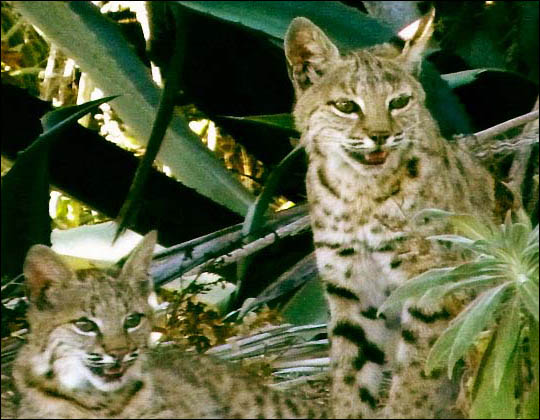
bobcats
Female and one of the kittens

Similar Posts

  • October 2015

    White-tailed Kites Have the Last Word! In the March News of this website we reported that there was evidence of potential nesting for the White-tailed Kite. This was welcome news as our famous signature raptor, a bird that historically lives and breeds in profusion on More Mesa had not produced a single chick for at least three years….

  • June 2007

    Many of you may remember the long and protracted campaign concerning the Hacienda Vieja Project.  From 2004 to 2006, the More Mesa Preservation Coalition fought through all the public processes to ensure that this development was appropriate for More Mesa.  We were deeply concerned about the size, bulk and scale of the proposed structures, as…

  • September 2005

    A New Feature MMPC is delighted by the numbers of Usage Survey web submittals we have received thus far. As those of you who have completed the survey are aware, the last line is available for any comments the respondent may wish to make. We are very gratified by the fact that many of those…

  • July 2010

    More Mesa Preservation Coalition Celebrates 10th Anniversary This month the More Mesa Preservation Coalition celebrates its 10th anniversary!  In this very eventful decade, we have grown from a tiny cadre of less than 10 concerned neighbors in the More Mesa area, to a supporter base of 1000 community members from all over Santa Barbara county,…

  • April 2010

    ANOTHER AWARD:  The More Mesa Handbook is once again in the limelight!  This time as the winner of the Association of Environmental Professionals (AEP) “2010 Outstanding Public Involvement/Education Program” for the entire state of California! The award was conferred jointly to AMEC – Earth and Environmental, and the More Mesa Preservation Coalition website. The AEP…

  • MMPC Statement on Ongoing Coastal Act Challenges

    The More Mesa Preservation Coalition is closely monitoring ongoing efforts to weaken the California Coastal Act and the authority of the California Coastal Commission. Any reduction in these long-standing protections could increase the risk of future development pressures on More Mesa and other sensitive coastal resources. Maintaining strong coastal protections remains essential to preserving More…