June 2015

Lots of Special Birds

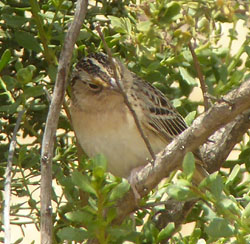
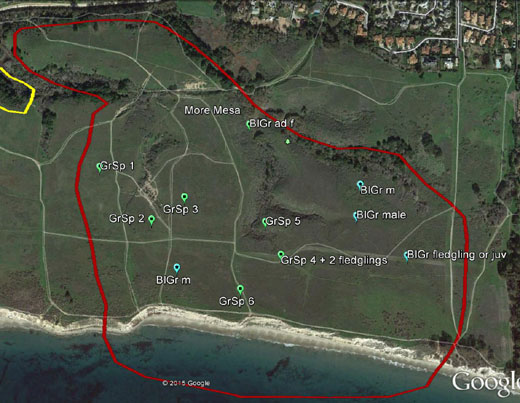
A wide area of More Mesa has been surveyed within the last few days. We are most happy to report that 34 different species were identified during this one survey. Among them were two raptors, a Peregrine Falcon and a Cooper’s Hawk. Also of very special interest were eight singing Grasshopper Sparrows and five Blue Grosbeaks. Moreover we are most pleased to relate that fledglings of these two species were observed as well!

We are indebted to Mark Holmgren for this extensive report, the details of which can be found at http://ebird.org/ebird/view/checklist?subID=S23709737

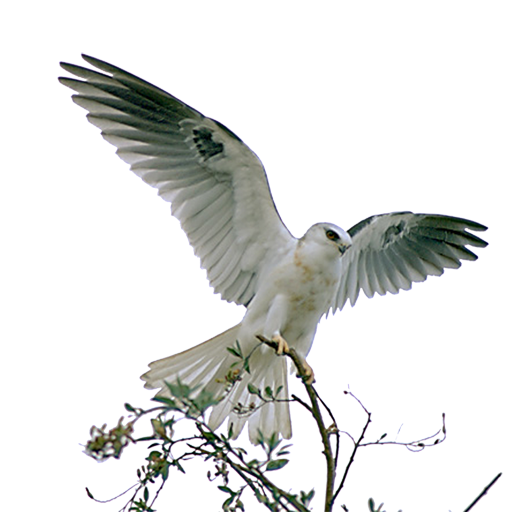
And, they are still with us … a kite was reported hunting on the west side of More Mesa on May 31!

2015MayNews01
Locations of Grasshopper Sparrow and Blue Grosbeak sightings.
2015MayNews02  2015MayNews03
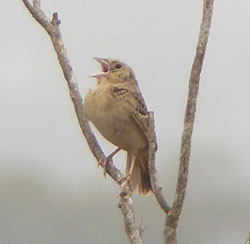
Grasshopper Sparrows

Similar Posts

  • April 2016

    Mother Nature Does Her Thing, Even with a Record Breaking Drought In spite of what is shaping up as yet another drought year, More Mesa is green and blooming. In one short walk we spotted Poppies, California Brittlebush, Blue-eyed Grass, Redmaids, Owl’s Clover and Miniature Lupine. Many of these were in profusion and all a…

  • February 2009

    We are pleased to announce that the More Mesa Handbook is here!  And, to celebrate this happy occasion, we are throwing a party!  Here’s the invitation … The More Mesa Preservation Coalition (MMPC) cordially invites you to participate in a gala gathering to launch the More Mesa Handbook, an informative, thorough and comprehensive look at…

  • January 2015

    And some rain came … Santa Barbara joyously welcomed the 6.3 inches of rain we received in December. Unhappily these rains represent only 20% of the yearly average rainfall in Santa Barbara and a very small percentage of the amount needed to end our three-year long drought. That being said, the growing things on More…

  • September 2014

    California is in a state of “Extreme Drought”, with 2014 being the driest year since 1895, 119 years ago! But, in spite of this disastrous condition, one can still observe some native wildflowers in bloom on More Mesa. For example, Deerweed, which normally blooms from March to October, has been in flower constantly for more than a year. Heavily…

  • December 2008

    As has been our tradition at the close of the year, we would like to share some highlights of what has been happening on More Mesa in 2008, and the work of the MMPC. Bio Study:  Field work, for the Updated Biological Resources Study requested by the owner of More Mesa, began in May of…

  • February 2008

    You may remember that a fire broke out on More Mesa in mid-summer of last year  (August 2007 News) Since last September, MMPC has routinely been monitoring the five acre burn area. Specifically, we were interested to see how both native plants, as well as invasive plants, were recovering, or colonizing, after the fire.  Twice…