February 2016

Caves Are No More

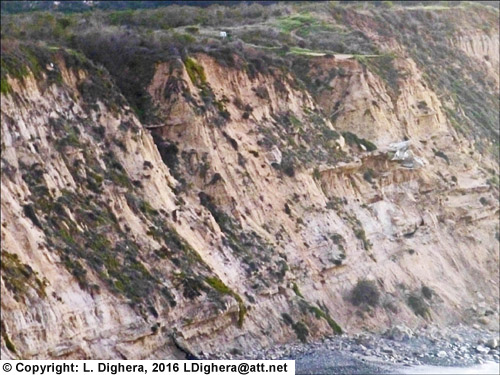
In several previous issues we discussed the dangerous erosion of the cliffs of the various sections of More Mesa. In October of 2014,  an incident where someone was hurt while in a cave on the western side of More Mesa precipitated a discussion of the geology of More Mesa’s cliffs. Specifically, we noted that the east side consists of a very old formation that erodes slowly, while the west, a much younger formation, erodes very quickly. In fact, sea cliff retreat in the this younger formation has been demonstrated to be about 10 inches a year, the highest rate observed along this portion of the South Coast. What this all means is that the western cliff is steep, unstable and unpredictable. At the time we advised everyone to stay out of the caves since they too, were judged unstable, unpredictable and dangerous.

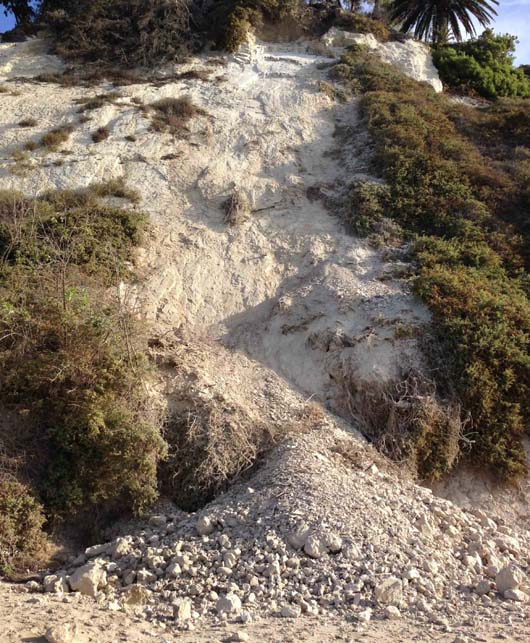
But now they are gone! These very same caves collapsed last week. County firefighters conducted a precautionary search and found no evidence of any victims being trapped during the collapse. Fire Captain Dave Zaniboni issued a warning that it is extremely dangerous now that the bluffs have caved in.

The Good News: Now that the caves have collapsed there is no longer any danger that people inside them will be injured or killed.

The Bad News: Once again, we remind everyone that the cliffs on the edge of More Mesa are UNSTABLE, UPREDICTABLE AND DANGEROUS. Please stay off the trails leading down from More Mesa and take extreme care when using the Coastal Trail. Please be safe!

2016Feb_news

Similar Posts

  • December 2006

    As the year comes to a close, we would like to share some highlights of MMPC’s work in 2006: In early May, the More Mesa Preservation Coalition (MMPC) hosted a Forum for all candidates seeking the position of Second District Supervisor. This two hour event was very well attended, with about 100 of our neighbors…

  • June 2015

    Lots of Special Birds A wide area of More Mesa has been surveyed within the last few days. We are most happy to report that 34 different species were identified during this one survey. Among them were two raptors, a Peregrine Falcon and a Cooper’s Hawk. Also of very special interest were eight singing Grasshopper…

  • June 2010

    Russian KnapweedLast fall the More Mesa Preservation Coalition reported that we were cooperating with County Parks, Channel Islands Restoration and Santa Barbara’s Agricultural Commissioner, David Chang, in a process to remove an extremely harmful invasive, known as “Russian Knapweed”, from More Mesa. At the time of the first phase of the eradication process, there was…

  • May 2004

    Earth Day Over 700 people visited the More Mesa Preservation Coalition booth on Earth Day! It was an extremely successful event. As well as talking to hundreds of people, we collected 75 additional names to be included in our data base of concerned community members. Check out photos in the Special Events section to get a sense…

  • August 2014

    Reptiles and Amphibians: In the past we have highlighted many of the biological resources found on More Mesa: birds, plants, mammals and, in last month’s update, our colorful insects, the butterflies. So it seems timely that the recent finding of a very long Gopher Snake shed should prompt this month’s discussion of the reptiles and…

  • More Mesa feature in Montecito Journal

    Featured in the Montecito Journal More Mesa Conservation Easement Established We’re honored to share that the Montecito Journal featured the More Mesa Preservation Coalition’s collaborative efforts with the Land Trust for Santa Barbara County and Santa Barbara County to permanently protect 36 acres of More Mesa. This milestone marks an important step toward ensuring More…