February 2008

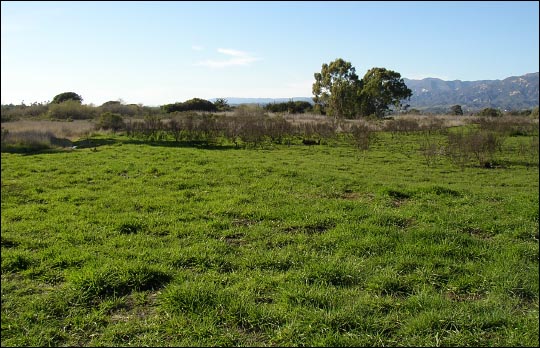
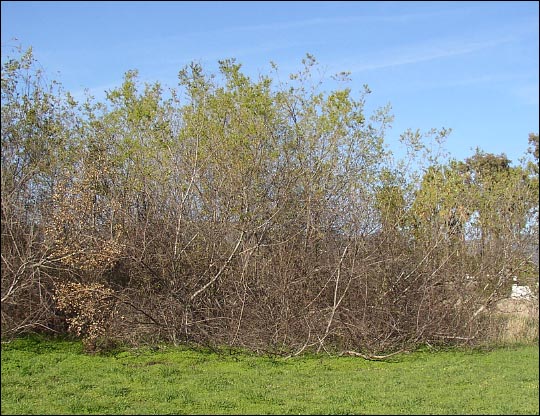
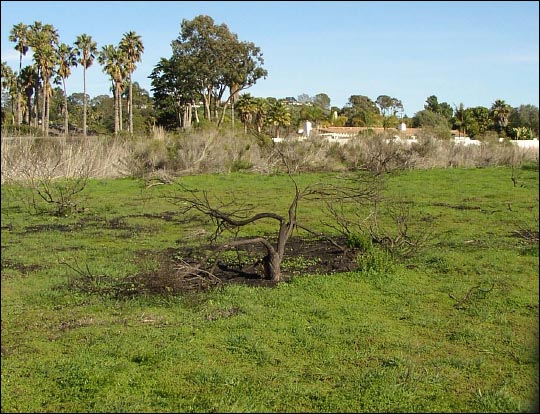
You may remember that a fire broke out on More Mesa in mid-summer of last year  (August 2007 News) Since last September, MMPC has routinely been monitoring the five acre burn area. Specifically, we were interested to see how both native plants, as well as invasive plants, were recovering, or colonizing, after the fire.  Twice monthly we observe specific areas and photograph the changes in different trees, shrubs and ground cover.

The Bad News:  Unhappily, all existing invasive species have made a robust recovery, except perhaps for fennel (which usually appears later in the year):

  • Malva and Radish are everywhere.
  • Harding Grass was slow to come up last fall, but now can also be seen in profusion.
  • Eucalyptus is recovering fully with shoots from the base of burned plants
  • Oxalis has covered almost all area with a thick, light green coating … which looks very pretty, but bodes ill for any native wildflowers.

The Good News: While many natives are recovering, the recovery is slower than that of the invasive species.  However, recent rains have benefited native plants so that:

  • Coast Live Oaks are showing shoots in the burned upper branches of young trees, as well as shoots from the bottom of main trunks.
  • Coyote Bush made a comeback in the fall and continue to be very robust.
  • Willows are showing signs of new leaves in the top burned branches as well as near the base of the trunks.

Spring is a beautiful time on More Mesa … even in the fire area!
coyote bush
Burned Coyote Bush

weeds
Invasive Plants

willows
Recovering Willows

Similar Posts

  • September 2004

    Second Update on Hacienda Vieja Project No changes were offered by the developer at the 25 August meeting of the Planning Commission. After another two hour session, the Commission reiterated the ideas expressed at the last meeting and gave additional, and even more specific, direction for changes they feel are necessary. These included redesigning at…

  • May 2005

    EARTH DAY In spite of threatening weather and competing events in downtown Santa Barbara, more than 400 people visited the More Mesa Preservation Coalition booth on Earth Day. A large fraction of these folks sought us out … to offer congratulations on the recent Coastal Commission decision (for a full hearing on the Hacienda Vieja…

  • November 2008

    Many different raptor species have been observed on More Mesa in the past few weeks.  These include: Peregrine Falcon Sharp-shinned Hawk Cooper’s Hawk Loggerhead Shrike Merlin Golden Eagle As evidenced by sightings of a female Northern Harrier Hawk, winter residents are also coming back.  A female Harrier has been seen in the northeast corner of…

  • February 2016

    Caves Are No More In several previous issues we discussed the dangerous erosion of the cliffs of the various sections of More Mesa. In October of 2014,  an incident where someone was hurt while in a cave on the western side of More Mesa precipitated a discussion of the geology of More Mesa’s cliffs. Specifically, we noted…

  • August 2006

    This month we would like to highlight a feature that was introduced to our web site several months ago … “Appreciation of More Mesa”.  “Appreciation” contains some of the comments from participants in our More Mesa Usage Survey.  We are grateful to these folks who have been kind enough to share their thoughts and feelings…

  • August 2015

    LATE BREAKING NEWS ABOUT DEVELOPMENT … Well, the day we knew was coming, but wouldn’t welcome, has arrived. On Tuesday, Kenneth E. Marshall, President of the development consulting firm Dudek, notified the Santa Barbara Planning Commission that he represented the Kalid Saud Al Shebaily Group (KSSG), the owners of More Mesa. He is joined by Jack Theimer…