October 2016

Earthquake on More Mesa?

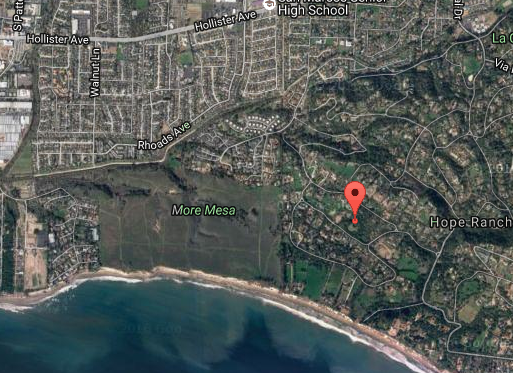
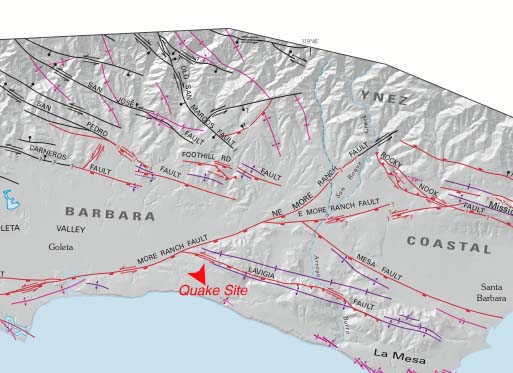
On the very first day of last month, at 8:42 in the morning, a magnitude 2.7, earthquake was reported for the More Mesa area. This event was incorrectly labeled in the press as the “Goleta Earthquake”. However in fact, the longitude and latitude of the quake epicenter placed it near a residence in Hope Ranch, about 1/3 mile due east of the edge of More Mesa (See aerial photo below.)

This low magnitude quake was not an unusual occurrence because our area, like most of California, is riddled with earthquake faults … and tremors are very frequent. For example, there have been 97 events of magnitude 1.5 or greater in Santa Barbara during the last year. The geologic map below shows various faults in the immediate area of More Mesa, with either black or red lines depending on the geologic deposits involved. Prominent among all the small faults shown, and at the north-eastern section of More Mesa, is the intersection of two larger faults, the More Ranch Fault and the Lavigia Fault.

To learn more about the geology of More Mesa, go to our 2014 Symposium videos and click on any of the titles. All Symposium videos will then appear on Vimeo. Geology is discussed in the talk titled “Ecology of More Mesa.”

We are indebted to the U.S. Geological Survey for providing the new and updated map geologic map of the Santa Barbara area, a map formulated with a major contribution from our own Dr. Edward Keller of UCSB.

earthquake-epicenter
2016-quake-site

Similar Posts

  • July 2016

    Why Collect Seeds Anyway? Last month we discussed the Coastal California Poppy and how the Cheadle Center for Biodiversity and Ecological Restoration (CCBER) collects seeds of this native plant on More Mesa. However, in addition to poppies, More Mesa is a very valuable source in the collection of many other important native plants. These include…

  • January 2016

    Our beautiful More Mesa looks bleak indeed! We need rain more than we have needed in almost 15 years! And, although we received a little rain exactly a year ago, the long awaited 2016 El Niño pattern shift has finally happened, to deliver rain for this season. Recent predictions based on anomalous elevated equatorial sea surface…

  • December 2004

    It has been a busy year for the More Mesa Preservation Coalition. Many hundreds of hours have been spent in proactive activities to preserve the beauty, habitats and wildlife of this lovely open space … March restoration event, providing information on native plants and invasive species, and observing and monitoring native fauna. In addition, more…

  • | |

    Unlocked

    The Most Wonderful Treasure…. As the end of the Lockdown approaches, I have been musing about how to “wrap up” our Treasure Hunts. How does one describe the entirety of the treasures of More Mesa … those few that I wrote about, and the hundreds of others that exist in this magical and remarkable place….

  • April 2016

    Mother Nature Does Her Thing, Even with a Record Breaking Drought In spite of what is shaping up as yet another drought year, More Mesa is green and blooming. In one short walk we spotted Poppies, California Brittlebush, Blue-eyed Grass, Redmaids, Owl’s Clover and Miniature Lupine. Many of these were in profusion and all a…

  • September 2016

    Time to Migrate The underlying reason for bird migration is survival: moving to areas with better food resources for the time of year. Birds move northward in spring, where they find abundant insects, flowering plants and in the less inhabited Northern Hemisphere, a higher number of nesting sites. However, as winter approaches and the availability…