October 2015

White-tailed Kites Have the Last Word!

In the March News of this website we reported that there was evidence of potential nesting for the White-tailed Kite. This was welcome news as our famous signature raptor, a bird that historically lives and breeds in profusion on More Mesa had not produced a single chick for at least three years. And as the months went by with no further nesting signs we despaired that 2015 would be yet another “no chick” year. Now, we are delighted to report that the kites have found a way!

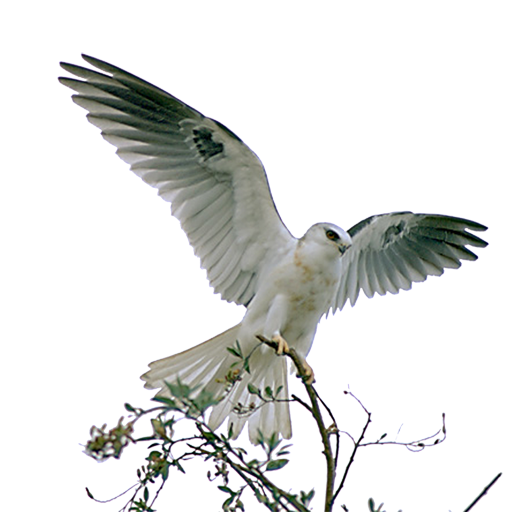
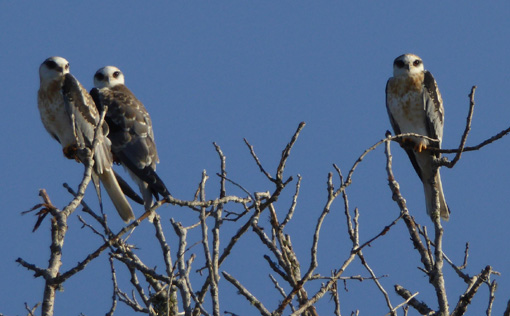
One of our most avid and dedicated birders, Jessie Altstatt, had been seeing one or two kites, all through July. Then, in late August she suddenly noted four kites. They were in the oaks close to Atascadero Creek on the north edge of More Mesa. Even more exciting was the conclusive identification of three juveniles among these four! The markings of juvenile kites are clearly shown in the accompanying photo, courtesy of Mark Holmgren. These are bold white margins on most of the dark feathers and gold breast feathering.

On another note, further identification revealed that this group was definitely not the family that bred in July at Lake Los Carneros.  Bottom line … this sighting, while it is exciting news for More Mesa, it is only our second kite breeding event in the entire Goleta Valley this season.

An additional observation about food, yields even further “food for thought.” The four birds reported were observed feeding on a larger mammal; perhaps a ground squirrel. This food choice is extremely interesting in that kites in the Goleta Valley almost always rely on California Voles, or to a lesser extent, on other vole-sized mammals as a food source.

2015oct
Fledged kites on More Mesa 2015, photo courtesy Mark Holmgren

Similar Posts

  • April 2007

    Spring has come to More Mesa.  Kites on the east side are nesting and we are expecting chicks soon.  Many hawks are also nesting on, and around, More Mesa. And although the Northern Harrier was seen on More Mesa on April 10, it should be leaving in the near future for its breeding territory. While…

  • June 2015

    Lots of Special Birds A wide area of More Mesa has been surveyed within the last few days. We are most happy to report that 34 different species were identified during this one survey. Among them were two raptors, a Peregrine Falcon and a Cooper’s Hawk. Also of very special interest were eight singing Grasshopper…

  • December 2005

    Once again it has been a very busy year for the More Mesa Preservation Coalition In March we published a Newsletter describing our activities in the past three years, and current threats to More Mesa . primarily from development around its edges. More than 1,000 Newsletters have been distributed to members of the community. The…

  • August 2006

    This month we would like to highlight a feature that was introduced to our web site several months ago … “Appreciation of More Mesa”.  “Appreciation” contains some of the comments from participants in our More Mesa Usage Survey.  We are grateful to these folks who have been kind enough to share their thoughts and feelings…

  • July 2008

    Since the Gap Fire has greatly heightened our awareness of fire, we are taking this opportunity to present a final update of plant recovery from the fire that broke out on More Mesa almost exactly a year ago.  That fire was described in our August 2007 News. Also, we previously presented an interim update concerning…

  • November 2015

    El Niño: A New Feature on our Web Site Weather is critical to what happens on More Mesa. Drought and its effects on More Mesa have been discussed over the last several years. Now with a “too-big-to-fail” El Niño about to alleviate some of that drought, a new section Ecology->Climate and Weather, has been added…