July 2007
Geology and Sensitive Species
Why do some parts of More Mesa support few, and generally familiar, animals, while others are home to some of the more sensitive species in our region? The answer lies partly in past geologic activity in the Santa Barbara region.
Santa Barbara is underlain with many fault systems, the activity of which has resulted in land-altering movement such as subsidence or uplift. Some of the more notable uplift areas are the Santa Ynez Mountains, Mission Ridge, the Mesa, and the coastal bluffs from UCSB to Hope Ranch including More Mesa. This variety of land forms has contributed to the many beautiful and diverse ecosystems in the region.
The uplift areas are “south side up” (south side is higher than the north side) and tend to impede groundwater movement toward the ocean. In the case of More Mesa, the catchment area is along the northern edge where the More Ranch fault is found, generally along Atascadero Creek, with many seeps and springs around the fault line. On the flatter portions of More Mesa, heavy rainfall results in the pooling of water. These wetland areas influence the activities of vertebrate and non-vertebrate species in the area.
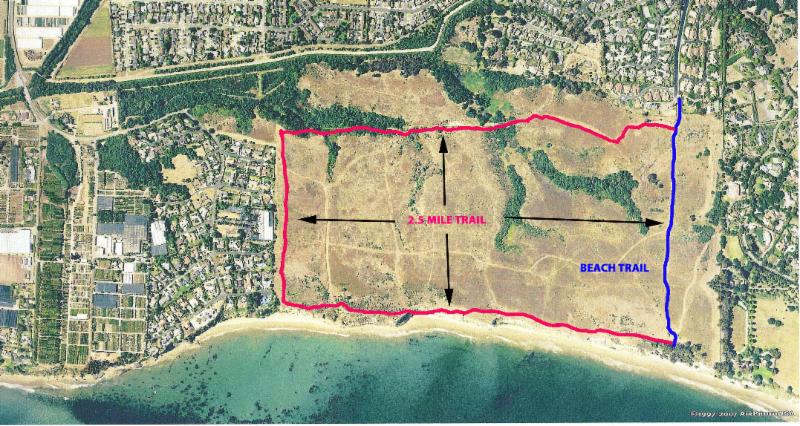
There are a variety of habitat types on More Mesa, including grassland, riverine, marsh wetland, and oak woodland. In particular, there is a large ravine on the east-central side in which water collects in winter, even in this year of low rainfall. Along the western side of the large ravine, a remnant of native Purple Needlegrass has been found. It was also in this general area, that some special bird species were recently seen and heard.
A greater variety of living things, including bird insect prey, are found in wetland areas. The proximity to these wetland areas of other habitats, seems to allow the residents of the latter to fare better.
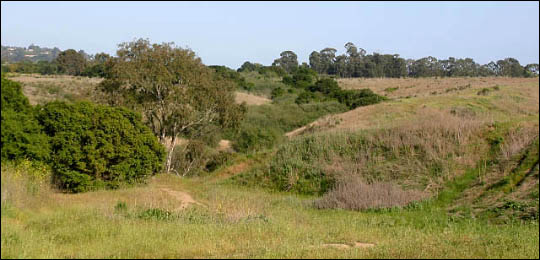
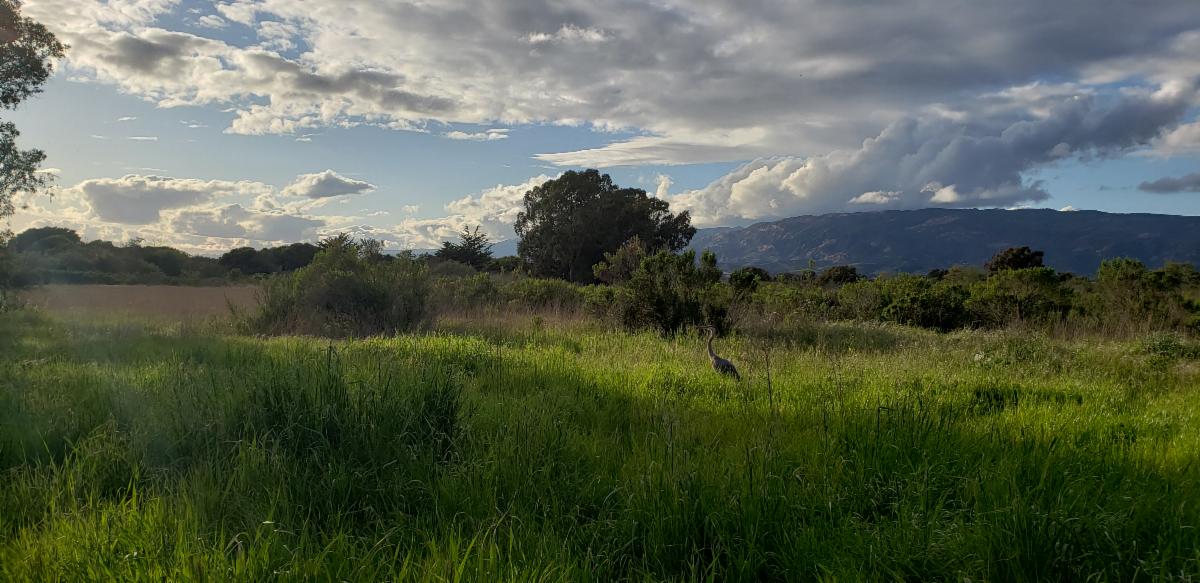
The large double-forked ravine funnelling down toward Atascadero Creek, with native grass in the foreground.
Sightings
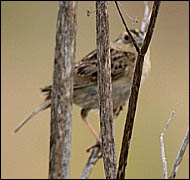
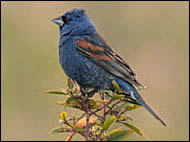
On June 10th, 2007, along the western bank of the large double-forked ravine on east-central More Mesa, two grassland bird species were seen – two Grasshopper Sparrow and two Blue Grosbeak males. Also, on June 10th, 2007, further along the More Ranch fault, near the county owned portion of northwest More Mesa, another sensitive species, the Swainson’s Thrush, was heard.
In 1978, California Department of Fish and Game prepared the BIRD SPECIES OF SPECIAL CONCERN IN CALIFORNIA, a document that still guides California in its management priorities. The authors chose to not grant Grasshopper Sparrow Special concern status, but wrote “ . . . there is no indication of any population decline, except perhaps in the southern coastal area, and birders seldom visit this species’ habitat to assess its true status”. This observation still applies, in that the status in coastal areas is largely unknown.
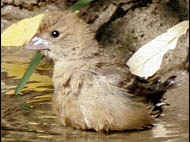
Over the last several years, the last time a Grasshopper Sparrow was seen on More Mesa was in 2005. Blue Grosbeak have been seen in this grassland area almost regularly over the years. In 2005, a newly fledged Blue Grosbeak was seen bathing in Atascadero Creek area adjacent to the ravine.
The use of these areas for nesting by the above species indicate that their habitats are in reasonably healthy condition.
|
Grasshopper Sparrow |
 |
|
Blue Grosbeak |
  |
|
Swainson’s Thrush |
|