September 2014

California is in a state of “Extreme Drought”, with 2014 being the driest year since 1895, 119 years ago! But, in spite of this disastrous condition, one can still observe some native wildflowers in bloom on More Mesa. For example, Deerweed, which normally blooms from March to October, has been in flower constantly for more than a year. Heavily populating the east-west coastal trail, it most likely prospers in this severe drought because it is a plant that is able to survive on the moisture left behind from the many fogs that visit us in spring and summer.
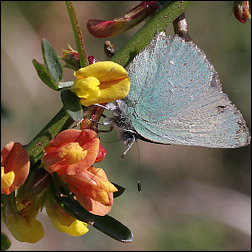
Deerweed, also known as California Broom, is not only resourceful, but has a fascinating adaptation. This dainty, native Chaparral plant has a clever way of attracting pollinators to the correct flowers. Beginning yellow, the flowers turn red after pollination.  Bees cannot see the color red, so it keeps them from wasting time on flowers that have already been visited.

In addition to the non-native honeybee, Deerweed flowers are pollinated by native bees in the Bombus, Hoplitus, Osmia, Agapostemon, Anthophora, Habropoda, and Anthidium  genera. [1] Deerweed is pollinated by butterflies (nectar source), and also serves as a host plant to many species of butterfly larvae. Once the flowers have been pollinated, the resulting seeds provide food for birds and rodents. Lastly, per its name, deer feed on the plant, where they are found together.
  

Similar Posts

  • December 2005

    Once again it has been a very busy year for the More Mesa Preservation Coalition In March we published a Newsletter describing our activities in the past three years, and current threats to More Mesa . primarily from development around its edges. More than 1,000 Newsletters have been distributed to members of the community. The…

  • May 2010

    Photographers of More Mesa Through the decade since our formation in 2000, our web site and publications have been graced with hundreds of images, images both scientifically important and amazingly beautiful.  All of these images have been generously donated to the More Mesa Preservation Coalition by many extremely talented photographers. Today we are proud to…

  • June 2005

    So far, we are aware of at least eight fledged chicks from the first broods of More Mesa’s kites. Since kites often have two clutches a year, this early count is an extremely heartening number. Last year, the total count, for the whole breeding period, for all four mated pairs, was ten. This early news…

  • April 2016

    Mother Nature Does Her Thing, Even with a Record Breaking Drought In spite of what is shaping up as yet another drought year, More Mesa is green and blooming. In one short walk we spotted Poppies, California Brittlebush, Blue-eyed Grass, Redmaids, Owl’s Clover and Miniature Lupine. Many of these were in profusion and all a…

  • March 2016

    El Niño Rains Haven’t Forgotten Us … They May Just Be Running Late If you are wondering what happened to the vaunted El Niño,  weather experts have stated that periods of sunny and warm weather are typical even in strong El Niño winters and that there is “No need to be alarmed that El Niño…

  • July 2014

    Summer Butterflies: If you have not already discovered it, we encourage you to check out one of our web site’s many slide shows of photographs of Butterflies seen on More Mesa. Furthermore, there is a downloadable pdf Guide.  And, happily, at this time of year you can see more and more of these local beauties in the…