
March 2008
In previous monthly news updates we have written of the Biological Resources Study Update that has been requested from the County by the owner of More Mesa. In this month’s news we will describe what we know about the process and ensuing actions that may, or may not, be undertaken by the owner subsequent to the completion of the study. The process requires pubic involvement at key points.
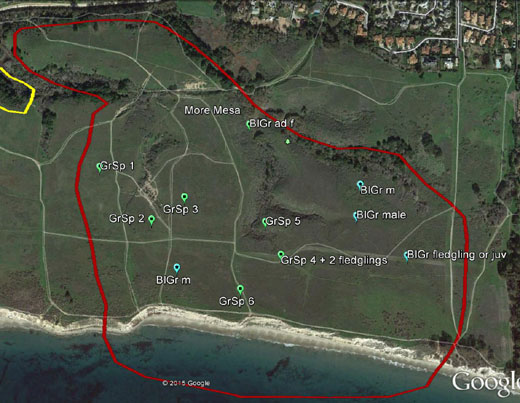
As we reported earlier, the existing Goleta Community Plan provides a process to change the developable area; a process that begins with conducting an updated Biological Resources Study. Subsequent to the owner’s request for such a study, the County requested bids from various companies and organizations and has received several responses. They are currently in the process of evaluating the bids. When this evaluation is complete, the owner, who is funding the study, will be allowed to make the final choice of who will perform the study. As we understand it, the steps in the process after this selection are:
- The Board of Supervisors (BOS) must approve the selection of the consultant team to perform this study. As part of this process, all proposals and rating information will become public. The BOS hearing concerning consultant selection will be an open public process that is ex pected to take place some time in April. The study, once begun, is proposed to be conducted over a period of a year or more.
- A draft report will be prepared and presented in a public forum such as a workshop. Comments from the public will be solicited at this time.
- Revisions and changes to the draft report may be made as a result of public input to the draft.
- At the end of the study, county staff will assess study results and, dependent upon consultant team findings, may make recommendations about development relative to what currently exists. That is, they may decide to rezone all, or portions, of More Mesa; a decision which has the potential to increase the area of More Mesa allowed for development and/or the number of units permitted to be constructed on More Mesa.
- Any changes that are recommended will have to be taken before appropriate decision makers; specifically, any changes to the environmentally sensitive habitat areas or land use and zoning designations would be subject to review and approval by the County Planning Commission, Board of Supervisors and eventually the Coastal Commission. Such changes are likely to require the preparation of a full environmental impact report aftercompletion of the biological study. There would likely be several public hearings spanning a multi-year process.
History shows us that the steps outlined above will extend over several years. We know this from experience during the 1980s work on More Mesa, and from comparable projects on the Ellwood Mesa and San Marcos Foothills properties. The 1980 Biological Resource Study of More Mesa and the resultant ESH and Land Use designations were the subject of an extensive biological evaluation and environmental review. The biological basis for the ESH designations was the subject of a remarkably detailed study conducted for over a one-year period by a team of impartial researchers from the University of California at Santa Barbara. These processes, and subsequent hearings, spanned a period of more than 12 years. Given the extensive scientific, public and legal discussion and debate that shaped More Mesa’s ESH and land use designations, any reconsideration of these matters must meet the same rigorous standards inherent and imposed in the original effort.