November 2016

White-tailed Kites!

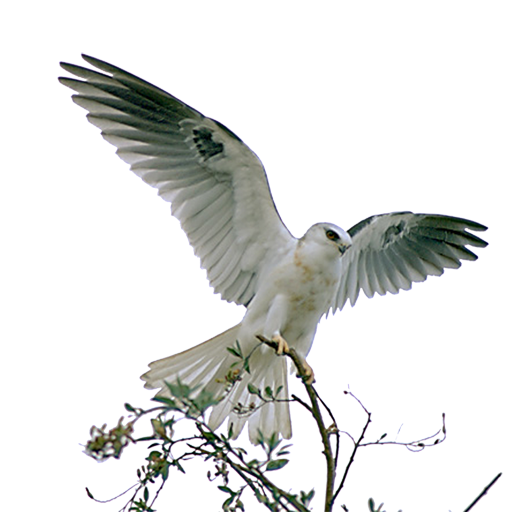
Although sightings of White-tailed Kites have been rare in this fifth year of the drought, we are happy to report that a pair of these special birds have been seen, very recently, on the eastern side of More Mesa, and on the western portion as well. While these two sightings may be of the same two birds, it is glorious news that even one pair is still here. And as we explored sources of information about our iconic bird, it appears that a pair actually fledged two chicks this past spring. The fledging, on western More Mesa, was one of only two reported nests in the entire Goleta Valley for this year. This information reminds us, once again, how important More Mesa is to the survival of this “California Bird of Special Concern”.

To learn more about this beautiful and important bird, visit two different articles hosted on our web site.

  • The first is a life history of White-tailed Kites and illustrated with many images of the kites at various stages of life: chicks, fledglings, courtship and breeding.
  • The second, titled “Vieja Kites”  is the fascinating story of a year when a pair of White-tailed Kites nested on Vieja Drive but hunted, and taught their young to hunt on More Mesa.

White-tailed kites are found almost year-round on More Mesa where they have well-established, historic nesting sites. In 2004, two of these sites were made unusable because of human activity. A homeless person camped under one of the nesting trees, and BMX bicyclists rode noisily under another.

Because of this, the first nesting attempt by the affected kite pair failed, and in a second attempt, the pair chose a stand of oaks at the end of Vieja Drive very close to More Mesa.
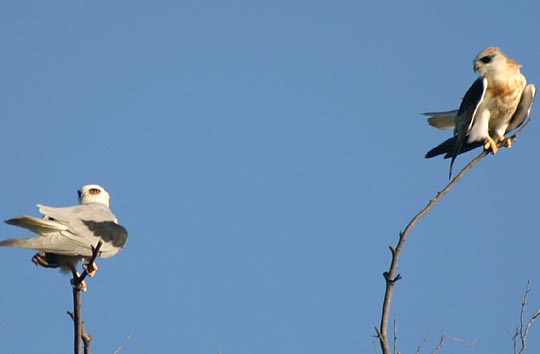

On More Mesa, adult kite on left, juvenile kite on right.

Similar Posts

  • May 2016

    Another Chapter in our “Cautionary Tales” Book:  It seems as though we have been relaying cautionary tales quite frequently. Exactly a year ago, and even more recently, we warned of the unstable nature of More Mesa’s cliffs and the heavy erosion that takes place, not only after rain, but even in dry weather. There is…

  • | |

    November 2017

    Big Day for More Mesa – County Approves Coastal Commision Recommendations As reported in our last update, the California Coastal Commission (CCC) was extremely supportive of MMPC’s positions on preservation of More Mesa, and supplemented them with even stronger language than currently existed in the new Eastern Goleta Valley Community Plan. At a meeting on November…

  • February 2016

    Caves Are No More In several previous issues we discussed the dangerous erosion of the cliffs of the various sections of More Mesa. In October of 2014,  an incident where someone was hurt while in a cave on the western side of More Mesa precipitated a discussion of the geology of More Mesa’s cliffs. Specifically, we noted…

  • |

    June 2016

    Coastal California Poppy – Eschscholzia californica var. maritima 2016 ​I ​Madonnari street painting festival – Robert Bernstein – click on image for original. This past spring More Mesa provided an amazing wildflower show, especially given the severe drought we are experiencing. And when one thinks of wildflowers, one species in particular often comes to mind.  It is the…

  • September 2010

    It’s Quadruplets! Last month we reported the presence of Northern Harrier Hawks on More Mesa … in summer … a most unusual occurrence.  And since early spring, we have also noticed some very atypical kite behavior.  That is, the historical “east” site, with its perching, hunting and nesting areas, has been nearly devoid of kites. …

  • |

    May 2008

    More Mesa Biological Resource Study – Status Update As reported in last month’s news, the County of Santa Barbara has selected Rincon Consultants to prepare the Updated Biological Resources study of More Mesa.  The Board of Supervisors approved the selection on April 15th , and the one-year study is now officially underway. White-tailed Kites We…