October 2010

Bobcat Family: Over the years, anecdotal, and very informal reports of Bobcat sightings have reached the More Mesa Preservation Coalition.  Moreover, we have never received any written or photographic documentation of these reports. However this year, it has become clear that a Bobcat family is frequenting More Mesa.  The mother was first seen in spring, reappearing  later, in July, with her mate and two kittens (sometimes referred to as “cubs”). It should be noted that, although mating is usually the only time that adult Bobcats are together, this male Bobcat seems to be genuine member of his little family!

Bobcats normally mate in late winter or early spring; although mating can occur at any time. In April or May, the female gives birth to a litter of kittens; typically three, though up to seven may be born.  At birth, weighing in at 10 ounces, the kittens’ eyes are closed.  In about ten days, the eyes open as bright blue, changing to yellow as they grow older. Young are weaned after 2 ½ months and stay with their mother for up to a year.  She begins teaching them how to hunt at about 5 months old.

Speculation is that the cats are coming down from the foothills and following the creeks. The increase in wildlife on the flats that has been noted since recent fires, is believed to be associated with loss of habitat.  We hope that all those who are privileged to see these magnificent animals will remember they are wild animals.  Please respect their presence, keep your distance and refrain from harassing them in any way (as this could be detrimental to their survival).  We trust that as the foothills recover from fire damage, Bobcat habitat will be restored and this family will be able to return to their ancestral hunting territory.
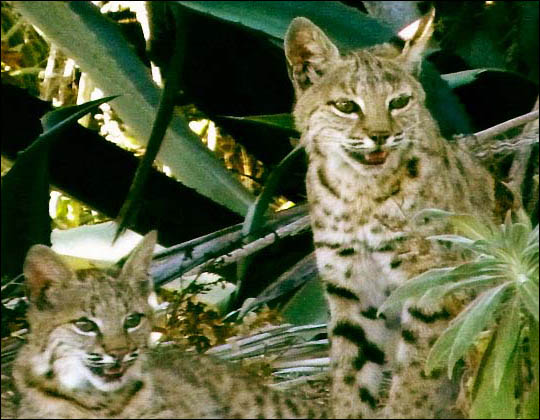
bobcats
Female and one of the kittens

Similar Posts

  • October 2015

    White-tailed Kites Have the Last Word! In the March News of this website we reported that there was evidence of potential nesting for the White-tailed Kite. This was welcome news as our famous signature raptor, a bird that historically lives and breeds in profusion on More Mesa had not produced a single chick for at least three years….

  • March 2016

    El Niño Rains Haven’t Forgotten Us … They May Just Be Running Late If you are wondering what happened to the vaunted El Niño,  weather experts have stated that periods of sunny and warm weather are typical even in strong El Niño winters and that there is “No need to be alarmed that El Niño…

  • May 2014

    Spring Has finally Sprung: The “Ghost of Spring” we have been experiencing as a result of the current drought is gone. It has been replaced by a solid body of delightful vistas and colorful flowers. The very short grasses are now two or three times taller and the brownish appearance of the whole Mesa has…

  • December 2014

    2014 … AN EXCITING YEAR FOR MMPC! Updated Web Site As a fitting symbol of welcome to the new year, our updated and completely revamped MMPC website went “live” very early 01/01/2014. The power of its new WordPress format was wonderfully proven all throughout this past amazing year. New formats, layouts, search tools, clear links…

  • March 2014

    Came The Rains … More Mesa on Sunday afternoon after three days of welcome rain. A lone native coastal poppy plant offers up two flowers. Fungi has enough moisture to make an appearance. Dogs make sport in a large pond at the coast.

  • February 2009

    We are pleased to announce that the More Mesa Handbook is here!  And, to celebrate this happy occasion, we are throwing a party!  Here’s the invitation … The More Mesa Preservation Coalition (MMPC) cordially invites you to participate in a gala gathering to launch the More Mesa Handbook, an informative, thorough and comprehensive look at…