March 2015

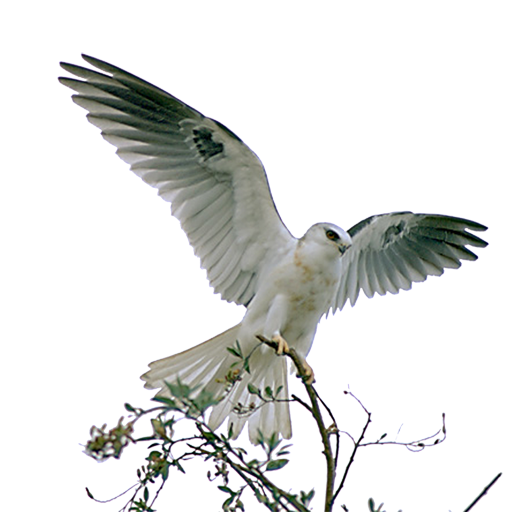
The White-tailed Kite, MMPC’s signature bird, is a “California Bird Species of Special Concern”. It has been given this designation because the White-tailed Kite was once at risk of disappearing, and is currently found in few places in California; one important area being the Goleta Valley. And within the Goleta Valley, More Mesa is one of the most prolific with regard to kite breeding and nesting. This is because it provides a bountiful habitat for many of these beautiful raptors.

Research has shown that a nesting pair of kites requires 150 acres of grassland to produce a clutch of healthy chicks. However More Mesa’s 265 acres routinely support more than a single pair. In fact in most “average” rain years, we have the largest number of nesting pairs in the entire Goleta Valley. Kite data gathered over more than 20 years shows that it is very common to have two nesting pairs, often three nesting pairs and in one incredible year, four nesting pairs!  When water is plentiful, the grasses grow, the rodent population has plenty of seeds and the kites then have ample prey to feed their young. In especially prolific years, we often have double clutching at one or more nests, and have even recorded up to 12 chicks in a given year!

Not even the lowest of these chick counts has been seen for the past three drought-years. For example, last year not a single chick was observed and only one lone pair of kites appeared to be living on More Mesa. However, there is some hope for this year. We have had a report of a pair of kites on the west side of More Mesa living on a nest site, guarding that site and also rearranging its nest material. We will keep you posted as the “courting season” progresses.

To learn more about kites, see:
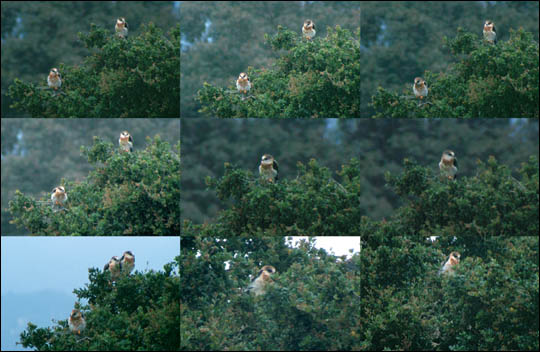
Four chicks at the central nest in 2003, when there were four nesting sites on More Mesa.

Similar Posts

  • | | |

    September 2011

    Stories of More Mesa Last month we shared one of our “Stories of More Mesa”; stories that tell the world what More Mesa means to the people who cherish it.  This month we present a second story, a different story, but the same theme. (If you, too, have a story you would like to share,…

  • |

    April 2015

    On the bright side … Although the drought has increasingly occupied our awareness over the past three years, there are a few bright lights to mention on More Mesa this month. In a previous issue this year we talked about various wildflowers that have been seen … not in great abundance, but they are around,…

  • | |

    February 2013

    Another Great New Resource on Our Website iNaturalist:  From hikers to hunters, birders to beach-combers, the world is filled with naturalists, and many of us record what we find. iNaturalist is a way to share these records on line. For example, you might discover someone who finds beautiful wildflowers at your favorite birding spot, or learn…

  • August 2015

    LATE BREAKING NEWS ABOUT DEVELOPMENT … Well, the day we knew was coming, but wouldn’t welcome, has arrived. On Tuesday, Kenneth E. Marshall, President of the development consulting firm Dudek, notified the Santa Barbara Planning Commission that he represented the Kalid Saud Al Shebaily Group (KSSG), the owners of More Mesa. He is joined by Jack Theimer…

  • |

    Living with the Lockdown – Treasure Hunt #5

    Today’s Treasure May Be Flying, Wading or Standing Still – But Always Breathtaking Today’s treasure starts with this lovely, pale blue egg. What emerges from this egg, after being incubated roughly a month?  It’s a Great Blue Heron Chick! During that month it will have been lovingly and periodically rolled (to keep its temperature constant)…