|

January 2009

Peregrine Falcon
In past Monthly News updates, we have encouraged bird enthusiasts who visit More Mesa to submit reports on what they see, via this web site. (Click on the button at the bottom of the home page or go to Contact > Sightings Report.)

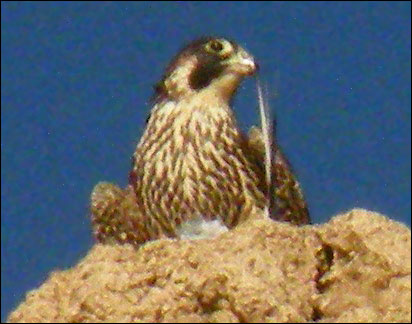
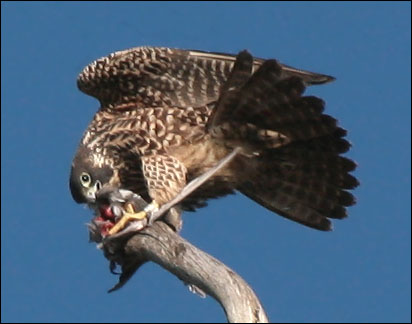
In the past few years, several of our supporters have used the web site to document regular bird sightings.  As a result, we are most happy to report that we recently received a marvelous sighting of a Peregrine Falcon near the coastal path of More Mesa … in the process of consuming a prey item!  This bird has been definitely identified as a juvenile Falco peregrinus anatum; a race that breeds in sub-arctic Alaska and Canada and throughout the western US.  This is very exciting news, since the last reported sighting of this species on More Mesa was in 2004.  We are indebted to Van Laurn, who is a frequent contributor to our sightings data base, for this report and the More Mesa photo below.  Initially there was also some concern about the nature of the prey item, until Van subsequently tracked down the carcass and positively identified the prey as a pigeon.

More Mesa Handbook
We will be launching the More Mesa Handbook at a morning get-together next month, and on this web site next month as well.  Watch for announcement of the time and place of the get-together; via e-mail and in the February News.

Thanks for caring about More Mesa, and a Happy New Year from all of us at the More Mesa Preservation Coalition!
mm
Juvenile Peregrine Falcon seen on More Mesa, January 7, 2009.
gs
Possibly same Peregrine Falcon seen at nearby Goleta Slough mouth, Dec 26, 2008. 
Similar Posts

  • | |

    February 2012

    The Eyes Have It! Why Is It That Raptors Have Such Great Vision? Many expressions are used to extol the incredible vision of raptors.  Most of us have used the phrase “Hawk-eyed”, or know someone we refer to as having an “Eagle Eye”.  And then, there is the oft-quoted football field analogy … “A Golden…

  • July 2007

    Geology and Sensitive Species Why do some parts of More Mesa support few, and generally familiar, animals, while others are home to some of the more sensitive species in our region?  The answer lies partly in past geologic activity in the Santa Barbara region. Santa Barbara is underlain with many fault systems, the activity of…

  • May 2009

    White-tailed Kites We are delighted to report that the eastern kite nest has already fledged three chicks.  The appearance of the juveniles has been documented as early as the middle of April! This extremely early fledging of three chicks bodes very well for a large number of chicks being produced on More Mesa this year. …

  • September 2016

    Time to Migrate The underlying reason for bird migration is survival: moving to areas with better food resources for the time of year. Birds move northward in spring, where they find abundant insects, flowering plants and in the less inhabited Northern Hemisphere, a higher number of nesting sites. However, as winter approaches and the availability…

  • September 2009

    Highlighting a Special Friend of More Mesa One of the delightful aspects of our Monthly News Reports are the wonderful photos of More Mesa that accompany each report. These photos, like almost all the photos on our More Mesa web site, have been created by Lynn Watson; our web manager and photographer extraordinaire. This month’s…