February 2016

Caves Are No More

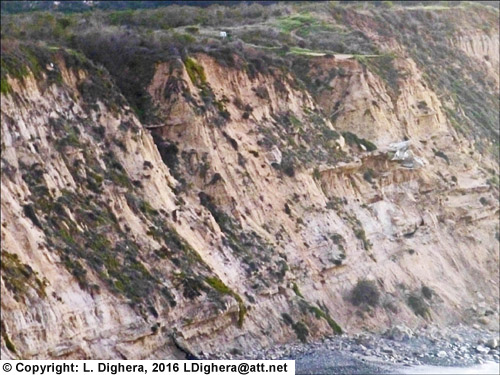
In several previous issues we discussed the dangerous erosion of the cliffs of the various sections of More Mesa. In October of 2014,  an incident where someone was hurt while in a cave on the western side of More Mesa precipitated a discussion of the geology of More Mesa’s cliffs. Specifically, we noted that the east side consists of a very old formation that erodes slowly, while the west, a much younger formation, erodes very quickly. In fact, sea cliff retreat in the this younger formation has been demonstrated to be about 10 inches a year, the highest rate observed along this portion of the South Coast. What this all means is that the western cliff is steep, unstable and unpredictable. At the time we advised everyone to stay out of the caves since they too, were judged unstable, unpredictable and dangerous.

But now they are gone! These very same caves collapsed last week. County firefighters conducted a precautionary search and found no evidence of any victims being trapped during the collapse. Fire Captain Dave Zaniboni issued a warning that it is extremely dangerous now that the bluffs have caved in.

The Good News: Now that the caves have collapsed there is no longer any danger that people inside them will be injured or killed.

The Bad News: Once again, we remind everyone that the cliffs on the edge of More Mesa are UNSTABLE, UPREDICTABLE AND DANGEROUS. Please stay off the trails leading down from More Mesa and take extreme care when using the Coastal Trail. Please be safe!

2016Feb_news

Similar Posts

  • March 2004

    Restoration Project on More Mesa County Park We have had a really gratifying response to our call for volunteers on the Restoration Project on More Mesa County Park! Where and When: We meet next Saturday, 27 March at 8:45 AM on the west side of More Mesa. To get there, proceed south on Patterson Avenue,…

  • September 2014

    California is in a state of “Extreme Drought”, with 2014 being the driest year since 1895, 119 years ago! But, in spite of this disastrous condition, one can still observe some native wildflowers in bloom on More Mesa. For example, Deerweed, which normally blooms from March to October, has been in flower constantly for more than a year. Heavily…

  • March 2006

    This month’s news brings you excerpts of a recent MMPC press release. South Coast residents face many challenges protecting our environment and quality of life, including traffic congestion, provision of affordable housing and protection of agricultural land and open space. Protection of irreplaceable agricultural land and critical open space is often the most hotly debated…

  • MMPC Statement on Ongoing Coastal Act Challenges

    The More Mesa Preservation Coalition is closely monitoring ongoing efforts to weaken the California Coastal Act and the authority of the California Coastal Commission. Any reduction in these long-standing protections could increase the risk of future development pressures on More Mesa and other sensitive coastal resources. Maintaining strong coastal protections remains essential to preserving More…

  • February 2008

    You may remember that a fire broke out on More Mesa in mid-summer of last year  (August 2007 News) Since last September, MMPC has routinely been monitoring the five acre burn area. Specifically, we were interested to see how both native plants, as well as invasive plants, were recovering, or colonizing, after the fire.  Twice…