
August 2014

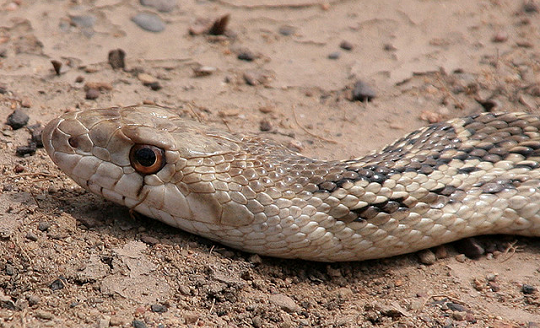
Reptiles and Amphibians: In the past we have highlighted many of the biological resources found on More Mesa: birds, plants, mammals and, in last month’s update, our colorful insects, the butterflies. So it seems timely that the recent finding of a very long Gopher Snake shed should prompt this month’s discussion of the reptiles and amphibians of More Mesa.

More Mesa is thought to support at least 22 species of reptiles and amphibians. Reptiles occur throughout all the habitats and include common species such as the Western Fence Lizard, Western King Snake, Gopher Snake and Slender Salamander, as well as sensitive species such as the Southwestern Pond Turtle. (Gopher Snakes as long as 8 feet have been observed on More Mesa.) On the other hand, amphibian species are concentrated within wetland and riparian areas and include the Western Toad, Arboreal Salamander and Pacific Tree Frog.

Gopher Snakes as long as 8 feet have been seen on More Mesa.

Gopher-1

Gopher-2

Similar Posts

  • May 2007

    Earlier this year, in the February News, the More Mesa Preservation Coalition reported that More Mesa was for sale … for $110 Million.  Shortly after this sale offering appeared in the “Multiple Listings”, the owner contracted with a local company to survey the property.  The “poles” and flags” that may be seen in various areas…

  • August 2007

    In mid afternoon of July 18th a fire broke out on the eastern edge of More Mesa.  Winds were potentially very dangerous. In fact, at first assessment, it appeared it might be difficult to contain the fire, which was spreading in a northwesterly direction.  However, within less than ten minutes, the Santa Barbara County Fire…

  • January 2006

    Many warm new-year wishes from all of us at the More Mesa Preservation Coalition! We sincerely hope that 2006 brings health, happiness and peace to all of you. Many folks are already thinking SPRING  and about new garden plantings for areas surrounding their homes. We would like to suggest that More Mesa lovers give serious…

  • September 2014

    California is in a state of “Extreme Drought”, with 2014 being the driest year since 1895, 119 years ago! But, in spite of this disastrous condition, one can still observe some native wildflowers in bloom on More Mesa. For example, Deerweed, which normally blooms from March to October, has been in flower constantly for more than a year. Heavily…

  • March 2016

    El Niño Rains Haven’t Forgotten Us … They May Just Be Running Late If you are wondering what happened to the vaunted El Niño,  weather experts have stated that periods of sunny and warm weather are typical even in strong El Niño winters and that there is “No need to be alarmed that El Niño…

  • November 2008

    Many different raptor species have been observed on More Mesa in the past few weeks.  These include: Peregrine Falcon Sharp-shinned Hawk Cooper’s Hawk Loggerhead Shrike Merlin Golden Eagle As evidenced by sightings of a female Northern Harrier Hawk, winter residents are also coming back.  A female Harrier has been seen in the northeast corner of…