October 2010

Bobcat Family: Over the years, anecdotal, and very informal reports of Bobcat sightings have reached the More Mesa Preservation Coalition.  Moreover, we have never received any written or photographic documentation of these reports. However this year, it has become clear that a Bobcat family is frequenting More Mesa.  The mother was first seen in spring, reappearing  later, in July, with her mate and two kittens (sometimes referred to as “cubs”). It should be noted that, although mating is usually the only time that adult Bobcats are together, this male Bobcat seems to be genuine member of his little family!

Bobcats normally mate in late winter or early spring; although mating can occur at any time. In April or May, the female gives birth to a litter of kittens; typically three, though up to seven may be born.  At birth, weighing in at 10 ounces, the kittens’ eyes are closed.  In about ten days, the eyes open as bright blue, changing to yellow as they grow older. Young are weaned after 2 ½ months and stay with their mother for up to a year.  She begins teaching them how to hunt at about 5 months old.

Speculation is that the cats are coming down from the foothills and following the creeks. The increase in wildlife on the flats that has been noted since recent fires, is believed to be associated with loss of habitat.  We hope that all those who are privileged to see these magnificent animals will remember they are wild animals.  Please respect their presence, keep your distance and refrain from harassing them in any way (as this could be detrimental to their survival).  We trust that as the foothills recover from fire damage, Bobcat habitat will be restored and this family will be able to return to their ancestral hunting territory.
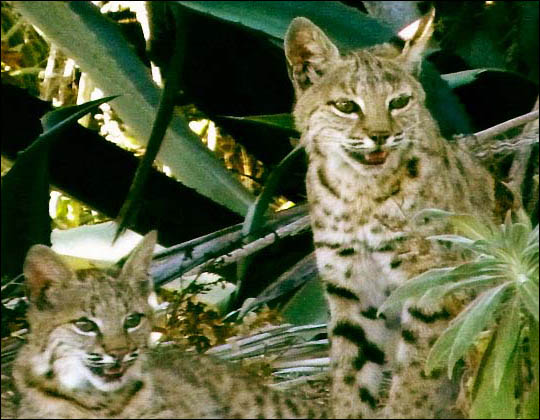
bobcats
Female and one of the kittens

Similar Posts

  • November 2015

    El Niño: A New Feature on our Web Site Weather is critical to what happens on More Mesa. Drought and its effects on More Mesa have been discussed over the last several years. Now with a “too-big-to-fail” El Niño about to alleviate some of that drought, a new section Ecology->Climate and Weather, has been added…

  • April 2010

    ANOTHER AWARD:  The More Mesa Handbook is once again in the limelight!  This time as the winner of the Association of Environmental Professionals (AEP) “2010 Outstanding Public Involvement/Education Program” for the entire state of California! The award was conferred jointly to AMEC – Earth and Environmental, and the More Mesa Preservation Coalition website. The AEP…

  • April 2007

    Spring has come to More Mesa.  Kites on the east side are nesting and we are expecting chicks soon.  Many hawks are also nesting on, and around, More Mesa. And although the Northern Harrier was seen on More Mesa on April 10, it should be leaving in the near future for its breeding territory. While…

  • February 2016

    Caves Are No More In several previous issues we discussed the dangerous erosion of the cliffs of the various sections of More Mesa. In October of 2014,  an incident where someone was hurt while in a cave on the western side of More Mesa precipitated a discussion of the geology of More Mesa’s cliffs. Specifically, we noted…

  • August 2014

    Reptiles and Amphibians: In the past we have highlighted many of the biological resources found on More Mesa: birds, plants, mammals and, in last month’s update, our colorful insects, the butterflies. So it seems timely that the recent finding of a very long Gopher Snake shed should prompt this month’s discussion of the reptiles and…

  • October 2015

    White-tailed Kites Have the Last Word! In the March News of this website we reported that there was evidence of potential nesting for the White-tailed Kite. This was welcome news as our famous signature raptor, a bird that historically lives and breeds in profusion on More Mesa had not produced a single chick for at least three years….