
March 2010

“Soft” Solution Offered to Solve Goleta Beach Erosion Problems
Since 2003, the County of Santa Barbara has been investigating ways to mitigate the loss of beach area at Goleta Beach.  These losses are attributed to natural erosion that occurs during winter storms, and especially, severe ones.  Both “hard” solutions, which employ structures and/or rockwork, and ”soft” solutions, which do not, can be used.  In 2008, the County settled upon a “hard” solution, in the form of a permeable groin, and went forward with that approach.

However, last November, the Coastal Commission, in keeping with it’s mission and policy, overwhelmingly rejected the “permeable groin” and directed the County to come up with a “soft” alternative; one that would both protect Goleta Beach, as well as eliminate any down-current erosion.  MMPC has been very involved in this process for more than six years, as the beach that is immediately down-current of Goleta Beach lies beneath More Mesa’s bluff top.  Proponents of the permeable groin project admitted that there would definitely be additional erosion to More Mesa Beach, and that it could also be very pronounced.

We are extremely pleased to report that the County has proposed an excellent “soft” approach, one that would protect both Goleta Beach, and More Mesa Beach.  Further, it would meet other important environmental needs.  This concept was unveiled at a meeting held on February 16, 2010.  The details of this initial phase, called “Goleta Beach 2.0” may be found at here.
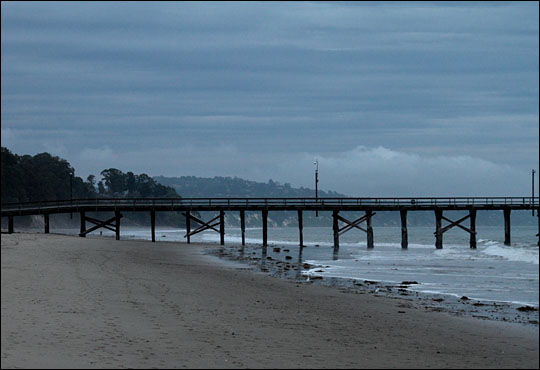
More Mesa from Goleta Beach
More Mesa cliffs from Goleta Beach, photo center in the distance.
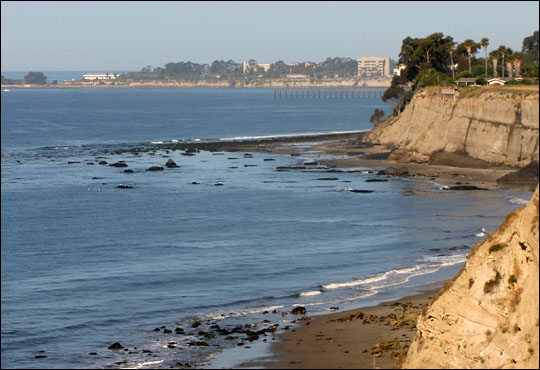
Goleta Beach from More Mesa
Goleta Bay and Pier from More Mesa cliffs.

Similar Posts

  • June 2010

    Russian KnapweedLast fall the More Mesa Preservation Coalition reported that we were cooperating with County Parks, Channel Islands Restoration and Santa Barbara’s Agricultural Commissioner, David Chang, in a process to remove an extremely harmful invasive, known as “Russian Knapweed”, from More Mesa. At the time of the first phase of the eradication process, there was…

  • May 2010

    Photographers of More Mesa Through the decade since our formation in 2000, our web site and publications have been graced with hundreds of images, images both scientifically important and amazingly beautiful.  All of these images have been generously donated to the More Mesa Preservation Coalition by many extremely talented photographers. Today we are proud to…

  • January 2008

    So many of our supporters have expressed a great desire to do something concrete to preserve More Mesa.  Now there is a chance to do just that!  We need a “big presence” at an upcoming County sponsored Workshop on the planned More Mesa Biological Resource Study. This study, recently discussed in the November 2007 News, has been requested…

  • June 2014

    Bobcats On More Mesa Some of you may have seen the marvelous photos of Bobcats taken recently on the Douglas Preserve.  And, we are most pleased to report both evidence and a sighting a Bobcat on More Mesa as well; scat was reported on the west side and an animal was seen near Atascadero Creek…

  • January 2010

    Happy New Year from the More Mesa Preservation Coalition ! Although there has not been much rain so far this season, More Mesa is already becoming green and lush.  Many of our friends and neighbors have been celebrating the holidays with their families by strolling, hiking and riding out on More Mesa. And, our winter…