September 2014

California is in a state of “Extreme Drought”, with 2014 being the driest year since 1895, 119 years ago! But, in spite of this disastrous condition, one can still observe some native wildflowers in bloom on More Mesa. For example, Deerweed, which normally blooms from March to October, has been in flower constantly for more than a year. Heavily populating the east-west coastal trail, it most likely prospers in this severe drought because it is a plant that is able to survive on the moisture left behind from the many fogs that visit us in spring and summer.
Deerweed, also known as California Broom, is not only resourceful, but has a fascinating adaptation. This dainty, native Chaparral plant has a clever way of attracting pollinators to the correct flowers. Beginning yellow, the flowers turn red after pollination.  Bees cannot see the color red, so it keeps them from wasting time on flowers that have already been visited.

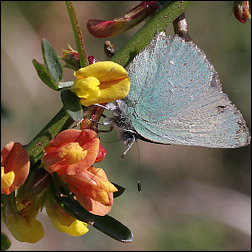
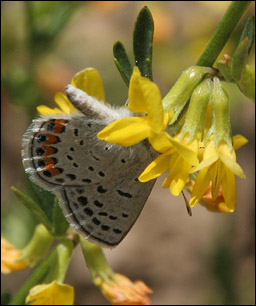
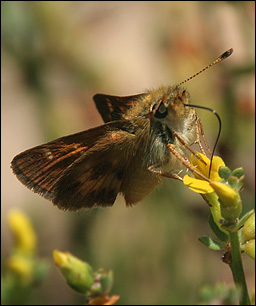
In addition to the non-native honeybee, Deerweed flowers are pollinated by native bees in the Bombus, Hoplitus, Osmia, Agapostemon, Anthophora, Habropoda, and Anthidium  genera. [1] Deerweed is pollinated by butterflies (nectar source), and also serves as a host plant to many species of butterfly larvae. Once the flowers have been pollinated, the resulting seeds provide food for birds and rodents. Lastly, per its name, deer feed on the plant, where they are found together.
  

Similar Posts

  • April 2014

    How Did the More Mesa Symposium Turn Out? The second More Mesa Symposium was held at Bren Hall of UCSB on Saturday, March 15th. All the feedback we have received has been overwhelmingly positive and the day seemed to be very appreciated by all. The event also had a nice write-up by Ray Ford in…

  • June 2014

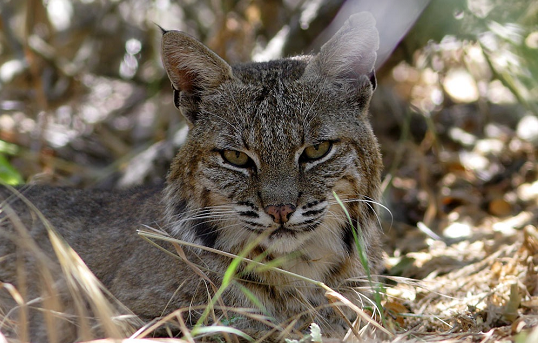
    Bobcats On More Mesa Some of you may have seen the marvelous photos of Bobcats taken recently on the Douglas Preserve.  And, we are most pleased to report both evidence and a sighting a Bobcat on More Mesa as well; scat was reported on the west side and an animal was seen near Atascadero Creek…

  • April 2006

    WHO WILL DO MORE FOR MORE MESA? You ask, they answer, then you decide whom you want for Second District Supervisor Last month’s news highlighted the importance of the upcoming election for Second District Supervisor.  In keeping with this theme, the More Mesa Preservation Coalition (MMPC) is pleased to sponsor an informal forum among the candidates…

  • December 2015

    2015 … The Year in Review The day we knew was coming, but wouldn’t welcome, arrived. In late July a group with the same members who circulated development plans for More Mesa three years ago, announced that they represented the Kalid Saud Al Shebaily Group (KSSG), owners of More Mesa. The new group’s opening salvo came…

  • December 2008

    As has been our tradition at the close of the year, we would like to share some highlights of what has been happening on More Mesa in 2008, and the work of the MMPC. Bio Study:  Field work, for the Updated Biological Resources Study requested by the owner of More Mesa, began in May of…

  • July 2014

    Summer Butterflies: If you have not already discovered it, we encourage you to check out one of our web site’s many slide shows of photographs of Butterflies seen on More Mesa. Furthermore, there is a downloadable pdf Guide.  And, happily, at this time of year you can see more and more of these local beauties in the…