November 2011

Plant List
An online plant list for More Mesa has now been compiled and loaded onto the web site. The entries on the list are derived from the 1982 and 2010 Biological Resources Studies, a list from the Santa Barbara Botanic Gardens, and a few other observations. Please click here for the list.

Native Plants Blooming on More Mesa
Whenever possible, the monthly news will feature some of the plants blooming on More Mesa at that time. Plants blooming in November are for the most part those that bloom year round, and are not limited to spring and summer flowerings.

More Mesa Native Plants – November
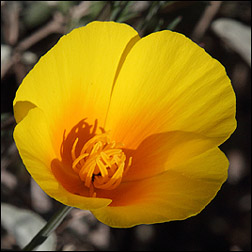
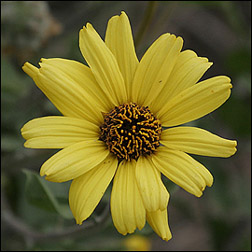
California Poppy – Coastal Variety California Bush Sunflower
poppy sunflower

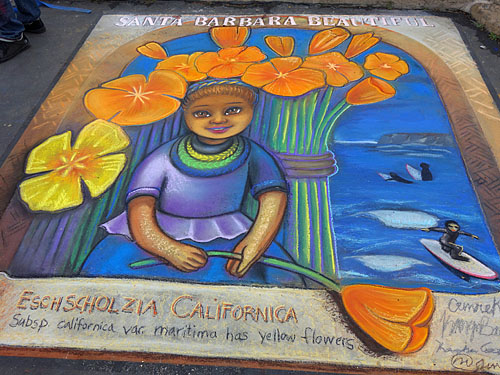
California Poppies have showy flowers and fine gray-green leaves. The flowers unfurl from a pointed cap, after which the petals open in sunshine, and close in the evening or cooler weather. Sometimes bees rest in the closed petals overnight. In warmer areas especially with coastal fog, they grow as several-year perennials. This variety is resistant to powdery mildew, and has yellowish edging to the petals. On seeding, the long and pointed capsules twist as they dry, to pop and scatter the seeds.

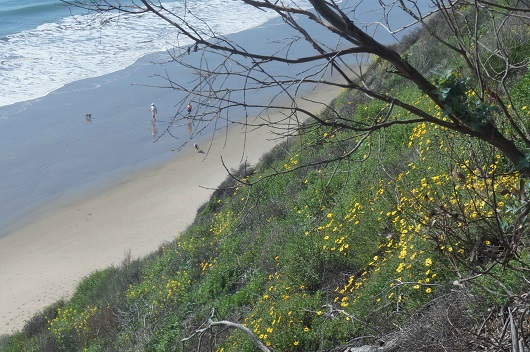
Bush Sunflower is a perennial shrub growing mostly on coastal bluffs and open slopes in coastal sage scrub and chaparral below 2000 feet. This shrub grows to a height of about four feet. Flowering can start as early as the first rains in fall, and continue through the moist months of spring. Under the right conditions, some flowering can even extend throughout the whole year. In hot and dry conditions, the plant ceases flowering and may lose leaves. Seeds are set during summer, and attract many native birds.

Similar Posts

  • |

    April 2013

    To Citizen Stewards For more than a decade, our supporters have been active citizen scientists by reporting sightings of rare birds, animals and plants that are observed on More Mesa.  These reports have contributed significantly to our base of scientific knowledge about this last remaining jewel of coastal open space.  Many in our community have…

  • May 2012

    A New Treasure This month, MMPC celebrates its twelfth anniversary. Often, in the course of those twelve years, we have made reference to the many “treasures” on More Mesa – birds, animals, plants, habitats, views etc. And now, just in time to celebrate our anniversary, we are delighted to report that yet another treasure has…

  • |

    July 2011

    A teaching moment … Although we have not had any documented fledglings at More Mesa, as yet, we have an amazing kite photo to share with you this month.  The image was taken by wildlife photographer Barry Rowan, late in May at Lake Los Carneros.  We thought it would be fun and informative to list…

  • | | |

    December 2011

    As another fairly quiet year on More Mesa draws to a close, and as has been our custom, we offer highlights of 2011. Updated Biological Resources Study More than eighteen months after field work for the Updated Biological Resources Study was completed, a draft report was issued by Santa Barbara County. The 429 page report, prepared by…

  • July 2016

    Why Collect Seeds Anyway? Last month we discussed the Coastal California Poppy and how the Cheadle Center for Biodiversity and Ecological Restoration (CCBER) collects seeds of this native plant on More Mesa. However, in addition to poppies, More Mesa is a very valuable source in the collection of many other important native plants. These include…

  • | |

    Living With the Lockdown – Treasure Hunt #4

    A Flower That Blooms for a Single Day … oops a Single Night! The plant we are featuring in this hunt, commonly known as Datura, and in the Nightshade family, is unusual in many ways. First it has several names, among them: Devil’s Trumpet, Devil’s Weed and Jimson Weed*. And, unlike the Miner’s Lettuce and Willow of…