No one would dispute we are in very troubled times. But while we are “Sheltering in Place” we are definitely not “Under House Arrest”. So, if you are tired of fixating on the Ups (number of cases of the virus) and the Downs (the stock market), the More Mesa Preservation Coalition offers you … a Treasure Hunt.
Santa Barbara is a wondrous place to live, especially in Spring. And, with recent rains, we are having an absolutely beautiful bloom … one that should be seen. Add to this happy thought the consul that, for both mental and physical health, we should go outside. While we would love to encourage you to go to More Mesa, any number of public parks or pathways will do just as well. PLEASE MAKE SURE THAT YOU ARE 6 FEET AWAY FROM ANYONE ELSE … even though you may have to shout out “Look at this!” very loudly.
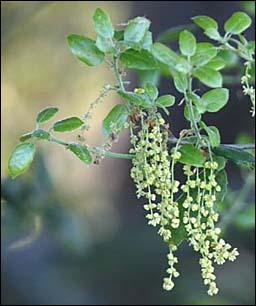
Today’s treasure is our incredible Coast Live Oak Trees that are currently in bloom. YES … in bloom. Oaks produce two types of flowers. First are the tiny yellow male flowers that cluster on long strands known as catkins. A catkin can contain 25-100 flowers and there can well be thousands of catkins in any given tree. The task of the male flower is to
Catkins
pollenate female flowers … preferably from another tree. Why does the tree produce so many male flowers? The answer is that pollination is done via wind power and not insects. Oaks are actually flowering plants; plants set apart from all others by a unique set of characteristics including their pollination technique and production of the acorn “fruit” that we see so many of in the fall.
While Coast Live Oak Trees can be found on the northern edge of More Mesa, they can also be seen on Ellwood Mesa, San Marcos Foothills Park, Hope Ranch and many public parks and bikeways throughout the Goleta Valley. Go find this first unique treasure!
Then a Treasure, Now Trouble…BIG Trouble…The Invasives Some invasive plants move from their home territories via stealth. They hitchhike on boots, backpacks, clothing, packaging containers and ship bottoms. But, by in large, most were purposely transported from their homeland by humans who thought they were treasures that would be valuable in other, far-away places. For…
A Tiny, but Powerful Member of the Animal Kingdom Prologue: When I sat down to write this week’s Treasure Hunt I had planned to introduce one of my favorite and hard-working little plants, Deerweed. But as I got deeper into the research about certain aspects of Deerweed, I discovered a world of mind-boggling information on…
WHAT HAPPENS WHEN HISTORY FALLS INTO THE SEA? It All Starts with a Tiny Cactus This Treasure Hunt is not about a gift from Mother Nature, but a story about a telephone line. It begins a hundred years ago with, surprisingly enough, a gift from Mother Nature, a tiny Prickly Pear Cactus. This little plant…
MMPC’s Signature Bird … You may have noticed that there was no hunting for treasures last month. We guessed that you all were busy enough with the dual tasks of keeping safe and the holidays. Instead, you received a version of our yearly holiday greeting; a beautiful photo of a White-tailed Kite wearing a Santa…
Willow and Water Go Together Meet the Family The Willow Family consists of over 400 different species of trees and shrubs of the Salix genus – a group of moisture-loving plants that are native to temperate and cold regions in the Northern Hemisphere. Depending on the species, willows range in size from towering giants of 90 feet…
Prologue Today’s Treasure Hunt is about snakes. Unhappily, snakes have a really bad reputation. To start with, the word “snake” is firmly embedded in our language and used by millions of people who have never even seen a snake! We call someone who is treacherous or worthless a snake, and when an individual is untrustworthy,…