February 2015
Last month we reported on the beautiful greenery and grasses of More Mesa. This month we are pleased to present the next installment of emerging spring … flowers. A great many species are contributing to the show. And among all the introduced species (mustard, radish, Bermuda Buttercups, etc) there are some truly delightful natives popping out.
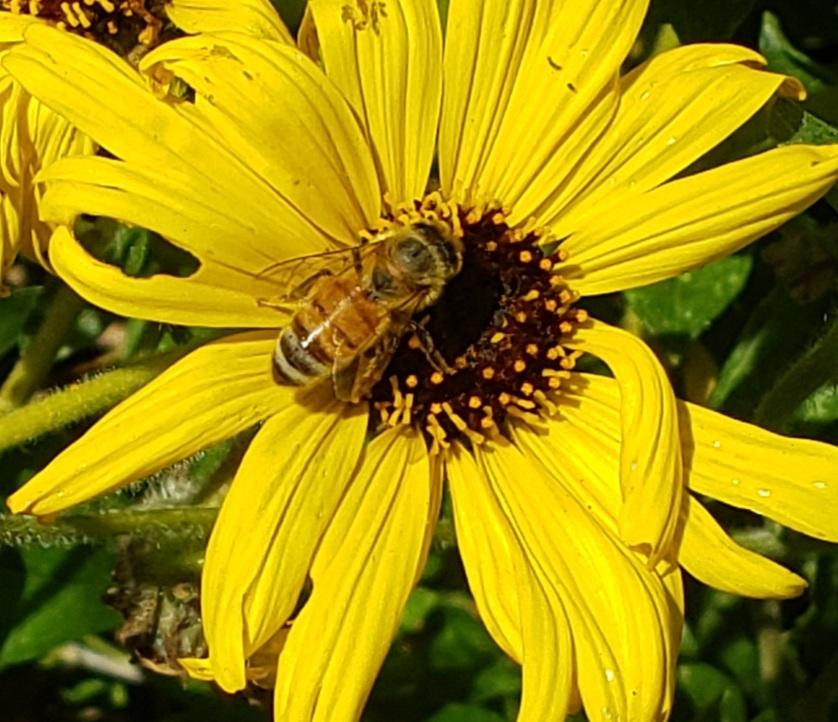
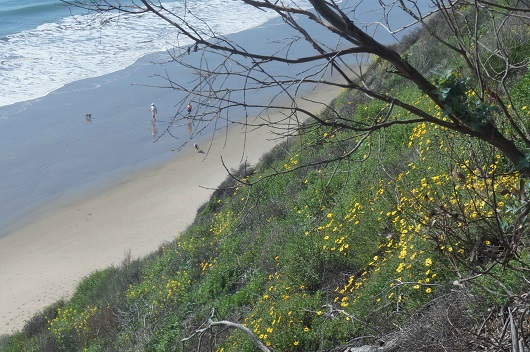
The most prominent, abundant and spectacular of these is the California Bush Flower (Encelia californica), a perennial shrub growing mostly on coastal bluffs and open slopes in coastal sage scrub below 2000 feet. On More Mesa, this drought-tolerant plant appears in profusion along the bluffs and on the coastal trail. It is a fast-growing, slope-loving plant with tenacious roots that limit erosion, as do the green leaves that disperse rain downpour before it reaches the soil. The large, bright yellow sunflowers attract bees, butterflies and insects that remain for a while to collect pollen, or consume nectar.
California Bush Flower grows to a height of about four feet and a width of about five feet. Flowering starts as soon as the first rains, and depending upon moisture can continue flowering through spring, summer and fall. Native birds consume the seeds, which are set in summer. The genus name Encelia comes from Christoph Entzelt, a German clergyman and naturalist who lived in the 1500s and wrote about the medicinal uses of plants and animals. (This plant is also called California Brittlebush, which can be confused with another plant with common name Brittlebush (Encelia farinosa), that grows further inland.)
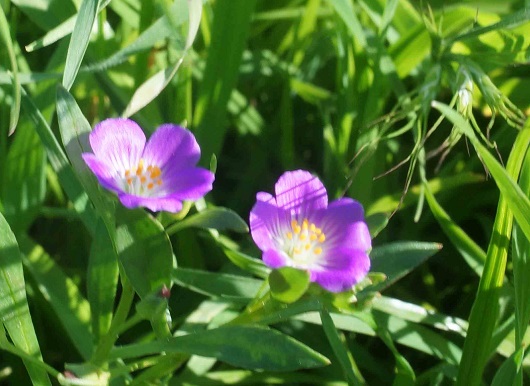
A little shyer and more difficult to spot is the diminutive and lovely Redmaid, a succulent carpet-forming plant having small brilliant reddish-pink flowers. These tiny treasures grow in open areas of woodland and grassland habitats, with sandy or loamy soils. Currently Redmaids can be seen along the north-south trail on the eastern side of More Mesa.
Within a few weeks other species of native flowers will be making their appearances all over More Mesa. We would love to hear about those you have seen. In addition to reporting birds and animals, you can also report flowering native plants on our sightings reports. Click “Sightings” on the home page of this web site.