February 2008

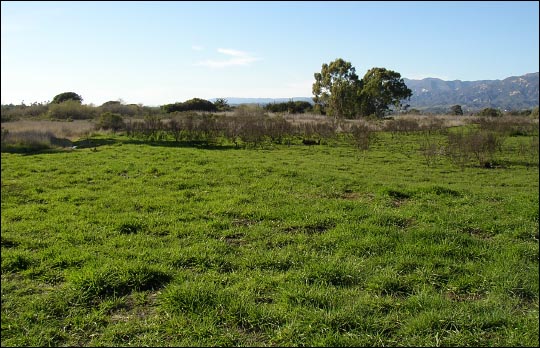
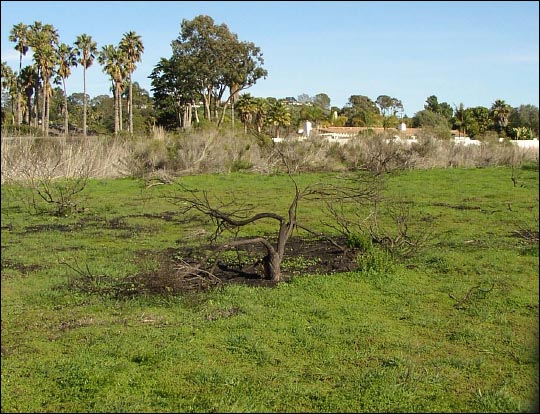
You may remember that a fire broke out on More Mesa in mid-summer of last year  (August 2007 News) Since last September, MMPC has routinely been monitoring the five acre burn area. Specifically, we were interested to see how both native plants, as well as invasive plants, were recovering, or colonizing, after the fire.  Twice monthly we observe specific areas and photograph the changes in different trees, shrubs and ground cover.

The Bad News:  Unhappily, all existing invasive species have made a robust recovery, except perhaps for fennel (which usually appears later in the year):

  • Malva and Radish are everywhere.
  • Harding Grass was slow to come up last fall, but now can also be seen in profusion.
  • Eucalyptus is recovering fully with shoots from the base of burned plants
  • Oxalis has covered almost all area with a thick, light green coating … which looks very pretty, but bodes ill for any native wildflowers.

The Good News: While many natives are recovering, the recovery is slower than that of the invasive species.  However, recent rains have benefited native plants so that:

  • Coast Live Oaks are showing shoots in the burned upper branches of young trees, as well as shoots from the bottom of main trunks.
  • Coyote Bush made a comeback in the fall and continue to be very robust.
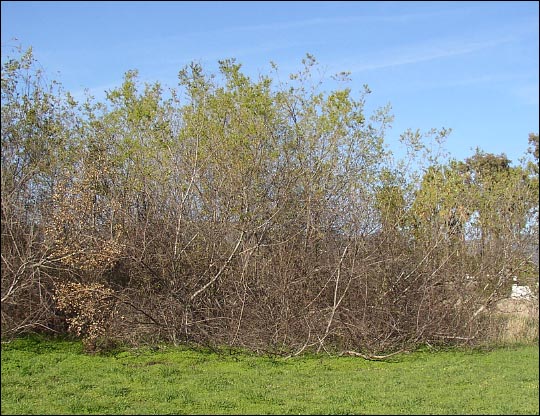
  • Willows are showing signs of new leaves in the top burned branches as well as near the base of the trunks.

Spring is a beautiful time on More Mesa … even in the fire area!
coyote bush
Burned Coyote Bush

weeds
Invasive Plants

willows
Recovering Willows

Similar Posts

  • March 2008

    In previous monthly news updates we have written of the Biological Resources Study Update that has been requested from the County by the owner of More Mesa.  In this month’s news we will describe what we know about the process and ensuing actions that may, or may not, be undertaken by the owner subsequent to…

  • March 2007

    In pursuit of our mission to preserve More Mesa forever, the More Mesa Preservation Coalition (MMPC) constantly strives to reach the broadest spectrum of our community with our message.  One technique we have used in the past is illustrated talks tailored to the needs of audiences such as Homeowners Associations, Fraternal and Service Organizations and…

  • May 2010

    Photographers of More Mesa Through the decade since our formation in 2000, our web site and publications have been graced with hundreds of images, images both scientifically important and amazingly beautiful.  All of these images have been generously donated to the More Mesa Preservation Coalition by many extremely talented photographers. Today we are proud to…

  • April 2004

    Restoration Event Our first restoration session in More Mesa County Park was held on the beautiful sunny morning of March 27th. Thirteen hearty volunteers showed up to hear Stephanie Langsdorf, of Growing Solutions, teach us the basics of the area’s ecosystem, and the particulars of natives and non-natives as well. Then, pitchforks and shovels in…

  • March 2004

    Restoration Project on More Mesa County Park We have had a really gratifying response to our call for volunteers on the Restoration Project on More Mesa County Park! Where and When: We meet next Saturday, 27 March at 8:45 AM on the west side of More Mesa. To get there, proceed south on Patterson Avenue,…

  • August 2006

    This month we would like to highlight a feature that was introduced to our web site several months ago … “Appreciation of More Mesa”.  “Appreciation” contains some of the comments from participants in our More Mesa Usage Survey.  We are grateful to these folks who have been kind enough to share their thoughts and feelings…