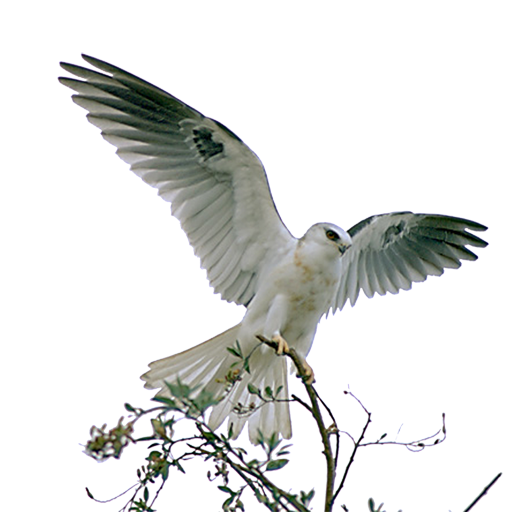
You may have noticed that we have not been very prolific in the “Update” department. And although the word “bleak” still comes to mind all too often, I think there are definite glimmers of hope. Among all the big problems is the one facing California and many parts of the west; the drought! Happily, More Mesa appeared to be taking that one in its stride … until recently. If you remember the last update (in early spring) we explored the chain of events that occurs in open spaces as a result of drought. That chain is: no rain means fewer grasses and much fewer seeds. Since rodents primarily eat seeds, there will then be fewer rodents. Finally, what is the primary food for the raptors on More Mesa? That would be rodents. As a result of this unhappy train of events, the kite population completely disappeared from More Mesa in the early part of 2022. All through the decades we have been watching our beloved kites, this has NEVER happened. Indeed, the situation was so grave that kites disappeared from the entire Goleta Valley.
How Could This Possibly Happen? We all know the drought is bad, but that bad? My initial look at the severity of the drought came from a paleontologist at Berkeley who grew up here in Santa Barbara. Professor B. Lynn Ingram provided historical context for the current drought. By measuring tree ring patterns throughout the Western United States, Professor Ingram and co-authors determined that the last drought of this severity occurred in AD 1580.
Worst drought in 500 years? That sounded ridiculous … until I read a more recently published study from a group at UCLA who contend that 500 years is not the correct number. Specifically, they report, “California and the American West, for much of the past two decades ranks as the driest 22-year period in at least 1,200 years.” Indeed, as I rummaged through articles on the collapse of the populous cities of the fabulous Mayan culture, I noted that drought and overpopulation ranked among the top reasons the Mayan culture collapsed. And one final conclusion of all these researchers, “Climate change, which is leading to increasing temperatures, is making the current dry period even more severe than it otherwise would have been”.
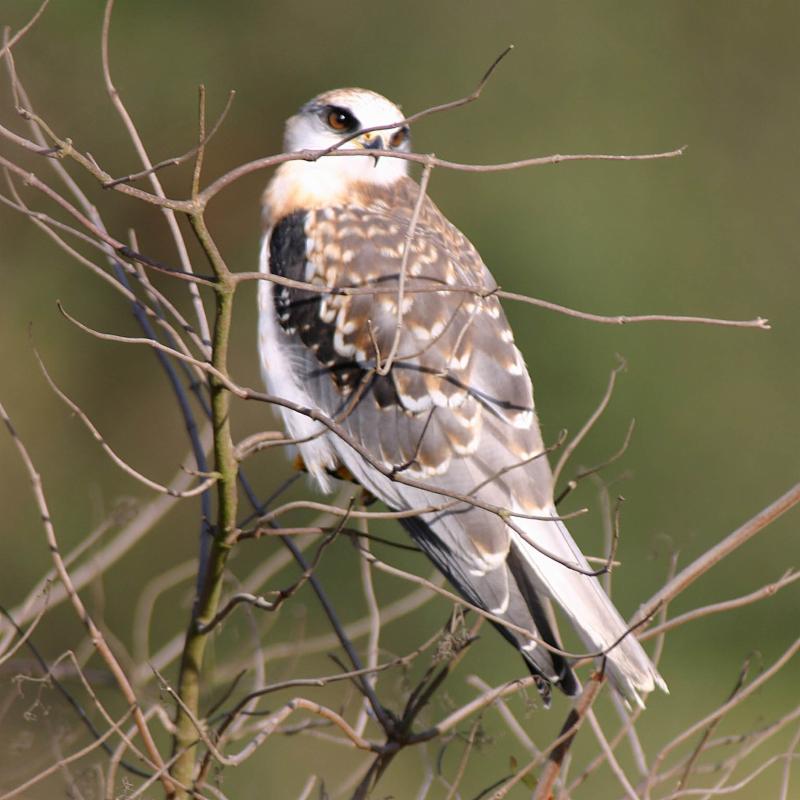
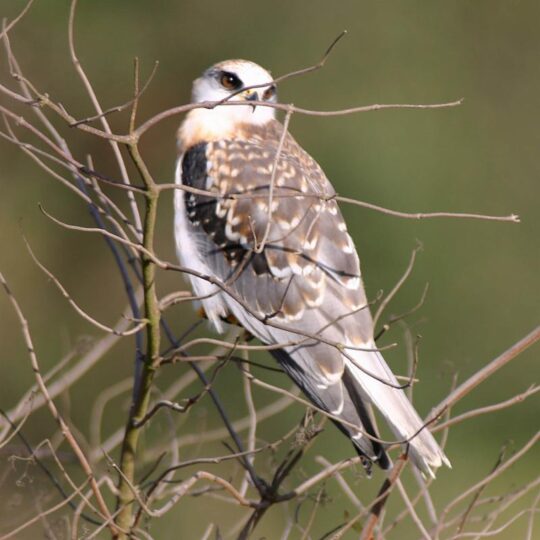
Amazingly Good News! So why are we writing now? WE ACTUALLY HAVE SOME REALLY GOOD NEWS. Kites have returned to More Mesa! At least two kites have been seen repeatedly on the west side of More Mesa and another bird on the east side as well. In addition, there appears to be another pair at Lake Los Carneros, as well as glimmers of hope for a larger population when we get some rain.
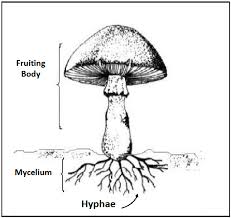
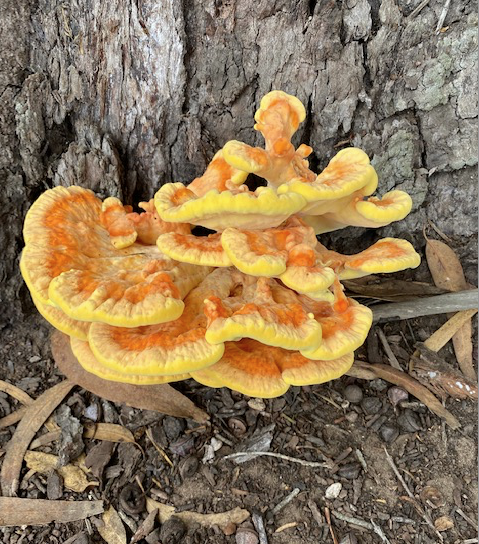
Lots of Humidity Brought Another More Mesa Surprise: Because More Mesa never disappoints, it offered up yet another treasure rarely seen here. The fogs and high humidity we experienced in September and October encouraged a new organism to appear, a fungi. Fungi are not plants, but a group of spore-producing organisms (molds, yeasts, toadstools and mushrooms) that have cell walls and feed on organic matter. Classic mushrooms have a “plant-like” form with a stem and cap above ground and most of the organism, called the mycelium, below. The mycelium is a network of threads, hyphae, that live underground and are responsible for “feeding” the fungi.) And for the first time in many decades of visiting More Mesa, we were fortunate enough to observe a rare resident of More Mesa, one that usually lives underground, a mushroom called “Sulphur Shelf” or “Chicken of the Woods”. This giant mushroom has an almost invisible “pseudo-stem” and a gloriously colored cap. The cap has small pores containing the spores on the underside instead of the traditional “gills” that we find in most mushrooms. (Spores provide a means of reproduction, dispersal and survival in poor conditions.)
Sulfur Shelf, or Chicken of the Woods
Where Are they? Mycelium of the Chicken of the Woods lives in, and feeds on, decomposing material all year round, whereas the beautiful mushroom we see above occasionally is just an outward representation (the fruit), and not necessarily an essential function for the fungus. Sulphur Shelf feeds on, and helps to decompose wood, so you will find it growing on dead trees, fallen logs, and stumps. (You may also, on occasion, find it on a live tree, where it behaves like a parasite and causes the wood to rot, eventually killing the tree.) At certain times Sulfur Shelf may also try to reproduce from spores released from the underside of the mushroom cap.
Because this organism is feeding on decomposing wood, the mushroom will be found at a specific location, over and over, until all the decaying material is gone. So, when you find one, remember where it was and look for it in the fall, at exactly that same place!
California has Two Subspecies of Its Very Own: Sulphur Shelf is found primarily in North America and Europe and has many, many subspecies. Indeed, as recent as 20 some years ago, two species were identified as specific to California; one that grows on conifers and one that grows on eucalyptus. Think Northern California and Southern California. It then follows that since we have so many eucalyptus on More Mesa, many of which are dying, dead or rotting, several Sulphur Shelf, (scientific name: Laetiporus gilbertsonii ); have appeared. The subspecies on More Mesa, like other Sulphur Shelf species, are very large mushrooms. However, ours are not as big as a member of another subspecies found in Great Britain. That mammoth specimen weighed 100 pounds! Ours are, however, quite large and very beautiful … with their striped, white, yellow and orange multiple layers; often piled high, one on top of another.
Edible? While many sources will tell you that these mushrooms are edible, caution is advised. Sources warn that the specimens not only have to be very new, but that whatever else you consume with the mushroom may determine the effect the whole meal may have on your digestive system. Suffice to say, BE CAREFUL!
It is the mission of the More Mesa Preservation Coalition to preserve More Mesa, in its entirety, for all time. We’ve been at it for almost 22 years.
Valerie Olson, president MMPC
Many thanks to Chris Brems who captured the beautiful photo of the Sulfur Shelf on More Mesa.
So far, we are aware of at least eight fledged chicks from the first broods of More Mesa’s kites. Since kites often have two clutches a year, this early count is an extremely heartening number. Last year, the total count, for the whole breeding period, for all four mated pairs, was ten. This early news…
Candidate Forum On May 11th, the More Mesa Preservation Coalition (MMPC) hosted a Forum for all the candidates seeking the position of Second District Supervisor. About 100 people were present to hear what each candidate had to say, with regard to specific questions about More Mesa, and Open Space in general. Feedback from supporters and…
NEWSLETTER Our four page, full color Newsletter update on conditions, on and around More Mesa and the activities of the MMPC, has been mailed. After only a few days, we already have had extremely positive feedback on this new publication. If you have signed on to our list of supporters and have not received the…
In many of our communications to More Mesa Preservation Coalition supporters, we have emphasized the importance of building a very large and powerful supporter base. MMPC stresses this point over and over, because, at this stage of our efforts to preserve More Mesa , it is crucial that all the people who care deeply about…
Since the Gap Fire has greatly heightened our awareness of fire, we are taking this opportunity to present a final update of plant recovery from the fire that broke out on More Mesa almost exactly a year ago. That fire was described in our August 2007 News. Also, we previously presented an interim update concerning…
So many of our supporters have expressed a great desire to do something concrete to preserve More Mesa. Now there is a chance to do just that! We need a “big presence” at an upcoming County sponsored Workshop on the planned More Mesa Biological Resource Study. This study, recently discussed in the November 2007 News, has been requested…