October 2016

Earthquake on More Mesa?

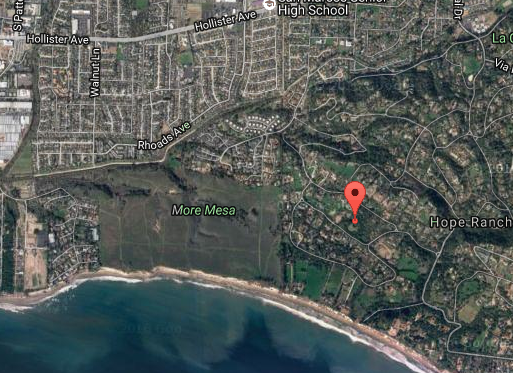
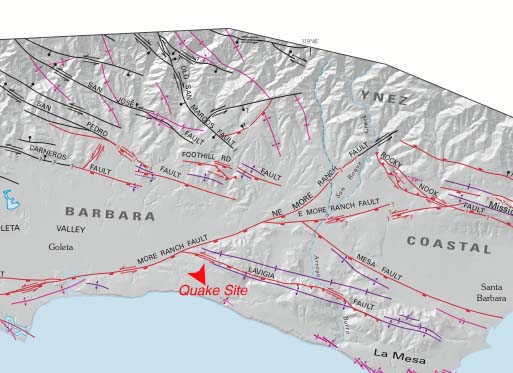
On the very first day of last month, at 8:42 in the morning, a magnitude 2.7, earthquake was reported for the More Mesa area. This event was incorrectly labeled in the press as the “Goleta Earthquake”. However in fact, the longitude and latitude of the quake epicenter placed it near a residence in Hope Ranch, about 1/3 mile due east of the edge of More Mesa (See aerial photo below.)

This low magnitude quake was not an unusual occurrence because our area, like most of California, is riddled with earthquake faults … and tremors are very frequent. For example, there have been 97 events of magnitude 1.5 or greater in Santa Barbara during the last year. The geologic map below shows various faults in the immediate area of More Mesa, with either black or red lines depending on the geologic deposits involved. Prominent among all the small faults shown, and at the north-eastern section of More Mesa, is the intersection of two larger faults, the More Ranch Fault and the Lavigia Fault.

To learn more about the geology of More Mesa, go to our 2014 Symposium videos and click on any of the titles. All Symposium videos will then appear on Vimeo. Geology is discussed in the talk titled “Ecology of More Mesa.”

We are indebted to the U.S. Geological Survey for providing the new and updated map geologic map of the Santa Barbara area, a map formulated with a major contribution from our own Dr. Edward Keller of UCSB.

earthquake-epicenter
2016-quake-site

Similar Posts

  • |

    August 2016

    A Tiny Bright Light In a world dominated by talk of drought, we offer a tiny bright spot … about a lovely native plant; Seacliff Buckwheat. While almost all of our More Mesa native wildflowers bloom in spring, this cliff and dune dwelling plant flowers in the middle of summer, providing nectar to many butterflies and insects….

  • September 2016

    Time to Migrate The underlying reason for bird migration is survival: moving to areas with better food resources for the time of year. Birds move northward in spring, where they find abundant insects, flowering plants and in the less inhabited Northern Hemisphere, a higher number of nesting sites. However, as winter approaches and the availability…

  • March 2016

    El Niño Rains Haven’t Forgotten Us … They May Just Be Running Late If you are wondering what happened to the vaunted El Niño,  weather experts have stated that periods of sunny and warm weather are typical even in strong El Niño winters and that there is “No need to be alarmed that El Niño…

  • April 2016

    Mother Nature Does Her Thing, Even with a Record Breaking Drought In spite of what is shaping up as yet another drought year, More Mesa is green and blooming. In one short walk we spotted Poppies, California Brittlebush, Blue-eyed Grass, Redmaids, Owl’s Clover and Miniature Lupine. Many of these were in profusion and all a…

  • January 2016

    Our beautiful More Mesa looks bleak indeed! We need rain more than we have needed in almost 15 years! And, although we received a little rain exactly a year ago, the long awaited 2016 El Niño pattern shift has finally happened, to deliver rain for this season. Recent predictions based on anomalous elevated equatorial sea surface…

  • |

    Welcome!

    The More Mesa Preservation Coalition (MMPC) is a group of concerned citizens committed to preserving More Mesa in perpetuity. Members include professionals, neighbors, conservationists, activists, scientists, planning specialists, students, hikers, equestrians, cyclists and beach goers. More than 1000 people have already signed on to be made aware of what is happening to More Mesa and…