Mysteries!
Spring came so late this year that it might as well have been a really long winter. But it is warm at last, and More Mesa has presented us with three different mysteries!
Mystery #1: What was actually found in our vernal pool
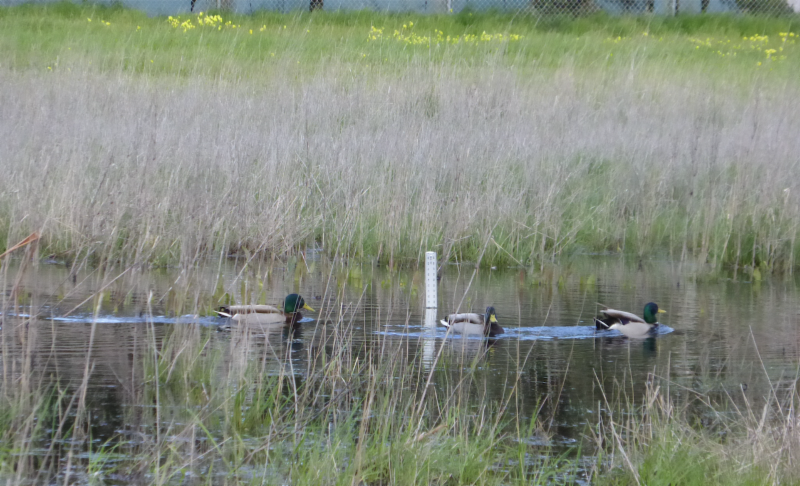
In our last issue we talked about the More Mesa Vernal Pool finally filling … after 8 long years of drought. Joanna Tang, a graduate student at UCSB, lead the scientific study of our pool with the aid of More Mesa supporter, Angela Rauhut, who took most of the measurements. Joanna has kindly written a synopsis of what she found after 3 months of study.
More Mesa has a vernal pool harboring several locally rare plants and animals that are vernal pool specialists. Even after being dry for 8 years, recent plant and animal surveys have revealed the resiliency of these special vernal pool species. They are adapted to live in aquatic conditions during the winter, reproduce and drop seed as the vernal pool dries out. Then they remain in the dried up pools as seeds and cysts (invertebrate eggs) that can withstand prolonged desiccation — just add water and they come to life!
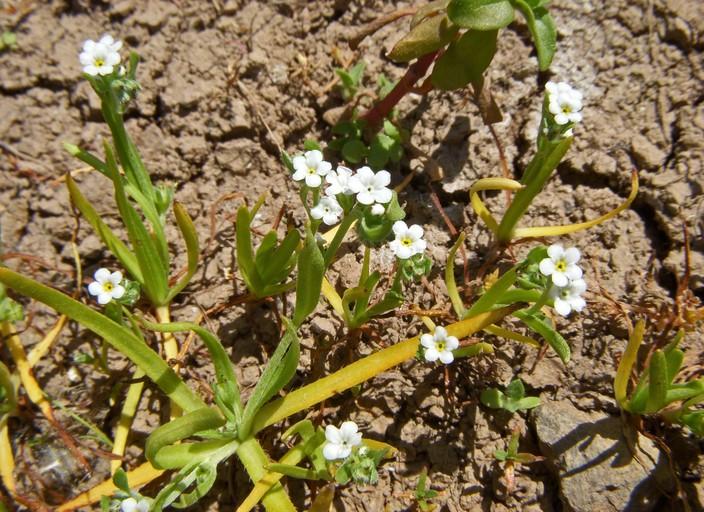
After this year’s winter rains, several vernal pool specialist plants popped up. There was, appropriately enough, Popcorn Flower, a common vernal pool plant in the area.
However, we also saw Pacific Foxtail and Lemmon’s Canary Grass, small native grasses that are only found in More Mesa and a few other pools near UCSB. Another plant found commonly in the local vernal pools is Coyote Thistle, but More Mesa’s Coyote Thistle has unique leaf and stem forms that may make it a distinct subspecies. Of particular interest, More
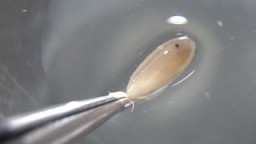
Mesa is the only local pool sampled this year that has Clam Shrimp — this little crustacean requires deeper vernal pools that stay filled with water for longer, so the large More Mesa pool is the perfect habitat for it! Other common freshwater invertebrates like Copepods and
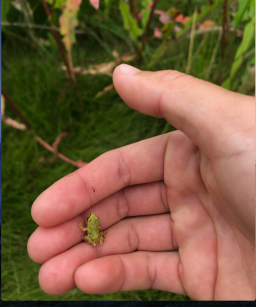
Ostracods were also found in the pool, as well as plenty of tadpoles of Pacific Tree Frogs!
It is so much fun to see the More Mesa pool come to life with so many species this year!
Our many thanks to Joanna and Angela for the data and photographs in this article.
Mystery #2: What’s going on with these big birds chasing one another?
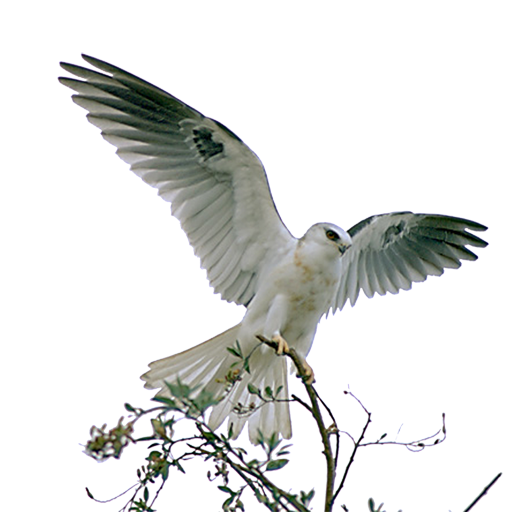
One recent early evening, two of our More Mesa fans were hiking on County owned More Mesa Open Space. They came across one large bird being loudly pursued by 2 or 3 other (perhaps smaller) birds. The pursuers disappeared quickly, but the bigger bird, resolutely and overtly, perched on a nearby tree with a huge portion of food clasped tightly in its talons. Fortunately the hikers managed to capture a photo of the perched bird and asked if it could be identified. The mystery thickened … what species and why the chasing?
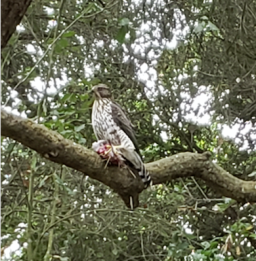
After studying a few books and sites, a rank amateur guessed it might be an immature Red Shouldered Hawk, but decided to get some real experts to weigh in. Oddly enough the experts were a little more than puzzled as well. The reason it was puzzling was that the bird in the photo was NOT an adult. It was an immature, meaning its in year 1 of its life. This ruled out the scenario where we would have an adult with food and juveniles chasing it. They might be chasing, but they were chasing an immature bird with prey, either a nest-mate or some other non-related bird. It seems a likely scenario that it was a group of young Cooper’s tussling for the food brought by an adult. However, the experts agreed that there was probably an adult around somewhere
The final verdict? The proud holder of the food was this Immature Coopers Hawk.
Many thanks to Rebecca Coulter, Krista Fahy and John Storrer for their help, advice and descriptions of what was likely happening.
Mystery #3: Why are the Locks on the Southeastern Gate Gone?
This mystery is not nearly as much fun as the ones above. The locks are gone because they have been stolen.
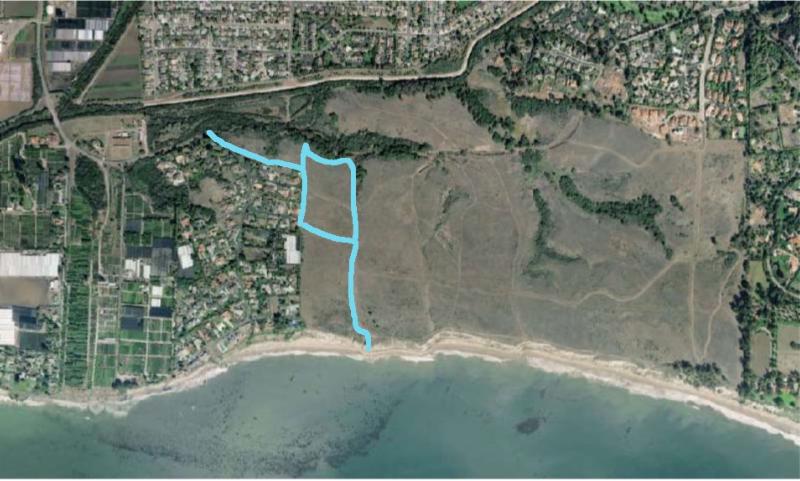
No private vehicles are allowed on More Mesa because of the potential for disastrous fires. A case in point: Twelve years ago, a fire on More Mesa burned to the edges of Hope Ranch and Vista la Cumbre. It started as a result of sparks from a motorcycle that was illegally being ridden on More Mesa.
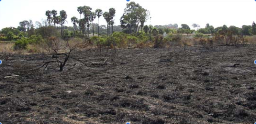
At that time the More Mesa Preservation Coalition took on the task of reducing the potential for fire on the eastern side of More Mesa. We collected private funds and obtained permission to finish the fence limiting entry onto More Mesa. After the fence was finished, we placed locks on the fire gate that would allow entry to those agencies that needed to have access to More Mesa. These included the owner of More Mesa, the Fire Department and the Sheriff. For many years these locks were in place and working well.
Unhappily emergency work by the gas company left the locks untended, and they were stolen. Because the special fire department locks are difficult to obtain, the gate was unlocked for several weeks. During that time, off-road vehicles and trucks decided to make More Mesa a playground and rode around in the mud after our frequent rain storms. Some of these vehicles got stuck and had to be pulled out by a tow truck. In one instance the tow truck had to be pulled out by a bigger tow truck. IT WAS A MESS!
A new set of locks was installed (several hundred dollars) and were gone the very next day. A third set disappeared in a few weeks. There is apparently a way to destroy any lock and chain … no matter how sturdy they are. Now there are no locks at all.
WE NEED YOUR HELP!! If you use More Mesa, please help to protect it. If you see vehicles illegally out on More Mesa, grab your cell phone and call the Sheriff. When you do this quickly, the Sheriff may get out there and confront the offender. We cannot let this magic place be destroyed by people who think they have a right to ride anywhere and everywhere their vehicles can possibly go. THANK YOU.