November 2011

Plant List
An online plant list for More Mesa has now been compiled and loaded onto the web site. The entries on the list are derived from the 1982 and 2010 Biological Resources Studies, a list from the Santa Barbara Botanic Gardens, and a few other observations. Please click here for the list.

Native Plants Blooming on More Mesa
Whenever possible, the monthly news will feature some of the plants blooming on More Mesa at that time. Plants blooming in November are for the most part those that bloom year round, and are not limited to spring and summer flowerings.

More Mesa Native Plants – November
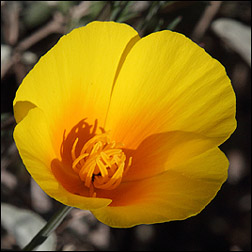
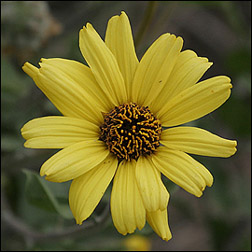
California Poppy – Coastal Variety California Bush Sunflower
poppy sunflower

California Poppies have showy flowers and fine gray-green leaves. The flowers unfurl from a pointed cap, after which the petals open in sunshine, and close in the evening or cooler weather. Sometimes bees rest in the closed petals overnight. In warmer areas especially with coastal fog, they grow as several-year perennials. This variety is resistant to powdery mildew, and has yellowish edging to the petals. On seeding, the long and pointed capsules twist as they dry, to pop and scatter the seeds.

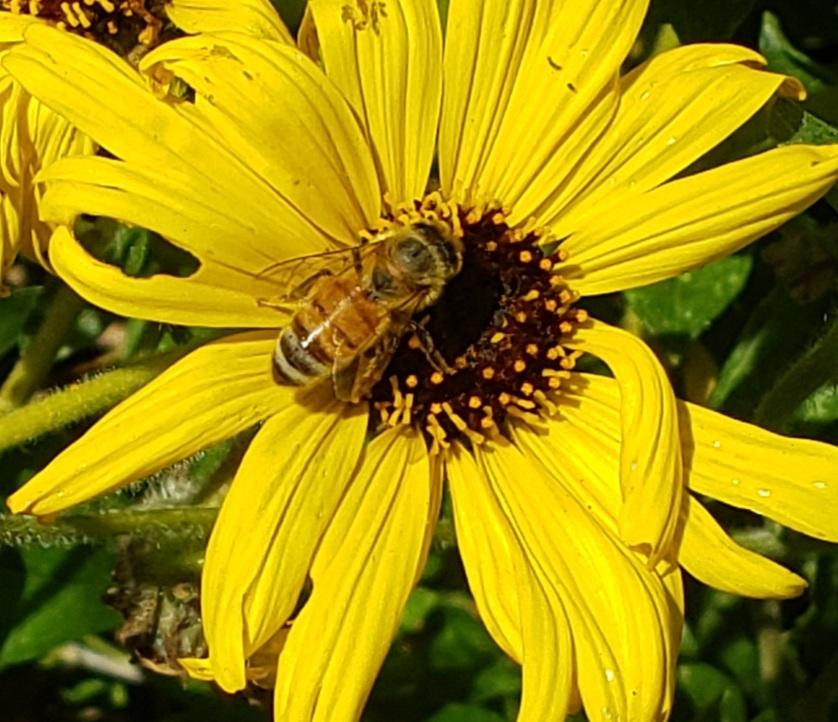
Bush Sunflower is a perennial shrub growing mostly on coastal bluffs and open slopes in coastal sage scrub and chaparral below 2000 feet. This shrub grows to a height of about four feet. Flowering can start as early as the first rains in fall, and continue through the moist months of spring. Under the right conditions, some flowering can even extend throughout the whole year. In hot and dry conditions, the plant ceases flowering and may lose leaves. Seeds are set during summer, and attract many native birds.

Similar Posts

  • May 2011

    Vernal Pools With all the emphasis on water in last month’s news, it seemed most appropriate that our web site should include a section devoted entirely to a very special water feature of More Mesa; its vernal pool.  As described in the More Mesa Handbook, as well as in the Draft Updated Biological Resources Study,…

  • March 2011

    Although March is “coming in like a lion”, there are already many signs of spring out on More Mesa.  Grasses are green (and high), wildflowers are starting to make appearances and our special raptors are courting and nest building.  The east kite pair is especially busy. Kite watchers may be interested in a story from…

  • June 2011

    Russian Knapweed: Three Times a Charm? Invasive weeds are extremely difficult problems in open spaces.  Getting rid of these interlopers, as soon as possible, is essential to preventing their spread. Since 2009, we have been reporting on efforts of County Parks (with some help from MMPC) to eradicate an area of Russian Knapweed on More Mesa….

  • |

    July 2011

    A teaching moment … Although we have not had any documented fledglings at More Mesa, as yet, we have an amazing kite photo to share with you this month.  The image was taken by wildlife photographer Barry Rowan, late in May at Lake Los Carneros.  We thought it would be fun and informative to list…

  • February 2011

    It has been several years since the More Mesa Preservation Coalition has reported on the growth of our supporter base, and how important it is to the success of our mission … to preserve More Mesa forever. Therefore, we would like to take this opportunity to reemphasize the significance of building this already large and…

  • July 2015

    An irritating reminder … Yet another manifestation of the drought concerns poison oak; harbinger of itchy rashes. If you have been out on More Mesa you may have noticed that our abundant poison oak populations have come up in profusion this year, and in spite of little water. And you may also be aware that poison oak being…